

You don’t have to believe in conspiracy theories to rethink your life setup. Sometimes it’s the weather, a tax bill, or a change in professional or private circumstances.
Many high-net-worth individuals in Germany are not aiming for a dramatic break with home, family, and community, but they are increasingly interested in options and the question:
“What would actually be possible if…?”
Which legal pathways would allow you to live and work in another country—if it became sensible or circumstances required it?
In Europe, this is comparatively straightforward: within the EU you can simply move your residence; freedom of movement and the single market mean legal and economic integration largely happen by default.
However, outside the EU you face different rules and much stricter entry conditions. The point is freedom of action—not panic.
One European special case is Switzerland: thanks to freedom of movement, relocation is possible in principle, but only with a residence permit—typically via an employment contract or proof of sufficient financial means including comprehensive health insurance.
The logic: if you want to stay, you must either be clearly economically embedded or be able to support yourself independently.
It doesn’t have to be Europe.
Outside Europe—say in the United States, Canada, or Australia—the hurdles rise quickly. It’s not enough to “register your address”; you need a legal framework that explicitly authorizes stay and employment.
If you want to live there without the right status, you’ll quickly hit hard legal limits: from reason for entry to permitted activity and tax residency. That’s exactly where interest is growing among Europeans: not out of wanderlust, but strategic prudence.
Investments learn English quickly
The U.S. combines economic opportunity with an investor-friendly, reliable legal system and high quality of life. More and more entrepreneurs, investors, and families from Germany, Austria, and Switzerland therefore ask how to secure the legal option to live and work in the U.S.—without burning their bridges in Europe.
Typical motives include:
- Diversifying life and business risks
- Business-friendly conditions
- Planning certainty for the next generation’s education and careers
- The desire to act deliberately rather than be surprised by events
The core point: only a clearly chosen status—residence right or visa—creates reality: entry and re-entry without uncertainty, clear work authorization, reliable tax classification, and thus true decision-making freedom. The guiding question is therefore:
Which residence and visa structures make this option legal, robust, and sustainable—especially in the United States?

What Types of U.S. Visas Exist?
For the U.S., there’s a clear split: Immigrant visas (permanent immigration with Green Card) and Nonimmigrant visas (temporary, purpose-bound stays without immigrant intent).
This distinction determines how you may enter, how long you may stay, what you may do there—and which obligations follow.
Immigrant Visa (Green Card)
The best-known path to permanent residence is the Green Card—the status of Lawful Permanent Resident. It comes with a clear expectation: your primary home is built in the U.S., with residence, tax liability, and real physical presence in the country.
Consequence: worldwide income is taxable under U.S. law, including income that might not be taxable in Germany. A classic example: selling a privately held property after ten years is usually tax-free in Germany—yet can still be relevant in the U.S.
Important—and often underestimated: the Green Card is not a blank check for maximum flexibility. Holders who mostly live abroad risk losing it. Authorities will test whether “permanent residence” is actually lived. Spending just a few weeks a year in the U.S. sends the wrong signal.
Green Card means settling, not dropping by.
Nonimmigrant Visas
Nonimmigrant categories are time-limited and purpose-bound.
Examples:
- Study (F-1)
- Specialty occupation (H-1B)
- Investment (E-2)
- Business/tourist (B-1/B-2)
These statuses enable a clearly defined stay—often for years via extensions—yet require that the underlying purpose continuously exists (ongoing studies for F-1, an operating business and active investor role for E-2).
A nonimmigrant status does not automatically lead to a U.S. passport or Green Card; that requires separate, formal processes. For many entrepreneurs this is exactly the value: legal presence without immediately taking on the full obligations of permanent residence.
In a nutshell
- Immigrant visas = permanent residence with all rights and duties, including worldwide taxation.
- Nonimmigrant visas = temporary, purpose-bound stay, extendable—without a claim to immigrate.
- A Green Card remains permanent only if the U.S. truly becomes your center of life; otherwise status is at risk.

What Is the E-2 Visa?
For many German-speaking investors, the E-2 Treaty Investor visa is the pragmatic bridge. It’s available to nationals of countries with an investment treaty—among them Germany, Austria, and Switzerland.
Essence: if you make a substantial, active investment in the U.S.—usually by acquiring or building a business—you gain the right to live and work there to develop and direct that enterprise. E-2 is not a “ticket you can buy” into America; it’s an entrepreneur’s visa that requires real activity.
What matters in practice
There is no fixed statutory amount; the investment must be substantial—proportionate to the model and proving viability. A token minimum won’t do; the test is business plausibility.
Operational reality is decisive: the business actually runs, earns revenue, creates (potential) jobs, and has a positive U.S. economic effect.
Passive assets are insufficient: a stock portfolio, a bank deposit, or an occasionally rented vacation home won’t qualify. Entrepreneurial substance is required.
Why E-2 fits entrepreneur families
E-2 delivers flexibility without forcing a one-way move. You can commute, build operations, work with local partners, or combine property investments with an active asset/business-management role.
You can also hold E-2 deliberately as Plan B—knowing that, with active management, status is renewable. That design suits investors who prefer measured steps over cutting ties with Europe.
Term & Extensions
Depending on the consulate and reciprocity schedule, E-2 visas are commonly issued for several years (often up to five years of visa validity). Each entry typically admits you for two years; this can be renewed continuously as long as the investment remains and the business is actively run.
In practice: if your company is well structured, documented, and managed, you can maintain E-2 long-term—without the complexity of a Green Card process.
At a glance
- E-2 = live and work in the U.S. based on an entrepreneurial investment.
- No obligation to emigrate for good—yet the option to do so gradually.
- Renewable while the business stays active and viable.
- Available only to treaty-country nationals (incl. DE/AT/CH).
- Goal: legal availability today; actual relocation later—when it makes business and family sense.
Core Eligibility Requirements
E-2 is attractive because the rules are clear—and attainable for serious entrepreneurs. Four points matter, and each must be visible in your filing:
1) National of a treaty country
Only citizens of E-2 treaty countries may apply. Germany, Austria, and Switzerland qualify. In partnerships, hold a majority stake or documented control so E-2 criteria aren’t diluted.
2) Substantial investment in a U.S. enterprise
The investment must be viable in size and structure. There’s no hard minimum, but in practice amounts below ~USD 100k are hard to justify in many industries, whereas successful setups are often capitalized significantly higher.
It’s not just the sum; it’s deployment: contracts, start-up costs, equipment, insurance, lease or service agreements, working capital—and a business plan that credibly shows revenue logic and cost structure.
Example (Business/Real Estate)
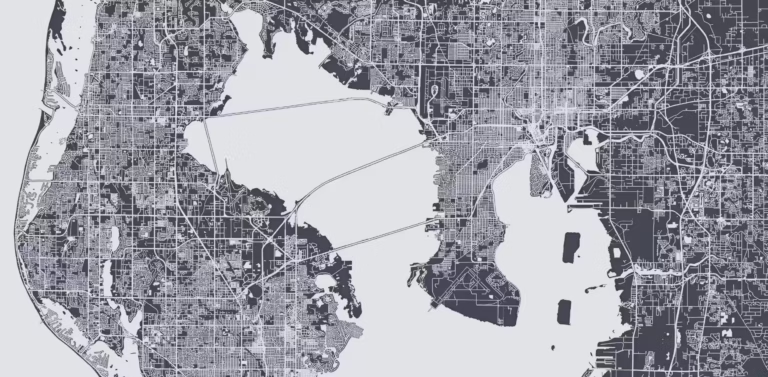
A German investor takes a majority stake in an operating U.S. company (e.g., an asset holding with property/asset management, vendor and lease contracts) in the Tampa region, together with a local operating partner—e.g., a partner like Whitestone Capital.
Capital is typically in the multi-million range; operations generate stable cash flow that supports U.S. living costs and scaling. This meets visa requirements and creates a robust Plan B.

3) Active, profit-oriented enterprise
E-2 requires more than a shell. You need real operations, visible revenue, and a profit goal. Sufficient examples include:
- A café/restaurant with staff and daily turnover, with clear supplier and lease contracts.
- An operational real-estate company with value-add strategy, renovations, leasing, vendor management, and demonstrable results.
Insufficient:
- Mere ownership of a vacation home that’s only occasionally rented (passive).
Commercial plausibility: the company should realistically support the applicant’s living expenses and, in time, go well beyond (jobs, profit, reserves).
A “micro structure” with ~USD 10k annual surplus won’t convince typical E-2 adjudication; entrepreneurial substance is expected.
Models like cafés or fix-and-flip require on-site presence or reliable local partners. If you’re not present daily, you must document the controlling entrepreneur role (budget, capex, contracts, staffing, banking authority)—e.g., in the operating agreement, board minutes, and banking rights.
4) Develop and direct
E-2 is not for passive capital. The applicant must develop and direct the enterprise—make key decisions and bear responsibility.
Examples:
- A Zurich investor builds a bakery chain in Miami, hires staff, selects sites, negotiates leases and suppliers, owns the budget.
- A German entrepreneur launches a consulting firm in Texas, acquires clients, negotiates, builds teams and processes.
Not enough:
- Installing a U.S. manager while you hold no leadership role. In partnerships, at least 50% ownership or documented control (e.g., in the operating agreement) is the common benchmark to satisfy E-2.
E-2 is no shortcut; it’s a clean framework that rewards activity. For wealthy families from Germany, Austria, and Switzerland, it provides full flexibility to establish a U.S. foothold—paired with the security that the investment generates substantive cash flow to support life there.

Practical Advantages of E-2
E-2 stands out for clarity and family friendliness. The principal applicant may live and work in the U.S.—not in the abstract, but to develop and run their own company.
Spouses and children are included
Spouses and minor children are part of the process; the family can relocate together or in deliberate stages. For option-seekers, that means legal availability without the pressure of immediate emigration.
Independent work authorization for the spouse
Upon entry, the spouse receives independent work authorization. That matters: they aren’t tied to the investor’s company; they can be employed, start a business, or freelance.
This independence eases integration, income, and career planning—and reduces the risk of the entire family’s logic depending on one business model.
Opportunities for children—and the age-21 threshold
Children gain a reliable path for schooling and life. Until age 21, they may live in the U.S., attend schools, and enroll at colleges or universities. After that, they need their own status—e.g., F-1 for study or, later, employment-based routes.
For families seeking international education for their children, E-2 is a real door-opener: predictable, lawful, without premature decisions about a permanent center of life.

Renewability
Another plus is how renewals work. Visas are typically issued for several years; each entry grants about two years of stay and can be extended as long as the investment remains and the enterprise is actively managed.
If you set up, document, and actually run the structure—contracts, revenue, staff, budgets—you can keep E-2 stable over time. That’s the difference between formal eligibility and lived practice.
Speed over complexity
Compared to classic Green Card processes, E-2 is faster. With coherent investment, plan, and evidence, status can be achieved within a manageable timeframe. Strategically, that speed matters to enter a market, win partners, or build on-the-ground presence.
E-2 provides exactly that bridge—legally robust, without the multi-stage procedures and queues common in many immigrant categories.
Bottom line
E-2 marries residence and work rights with flexibility and speed. It lets you step into the U.S. as a living business environment—not with a leap, but measured steps. Families gain an alternative to life in Europe that doesn’t force premature finality; it shifts decisions to the right moment—when they make economic and personal sense.
How E-2 Differs from Other Visas & the Green Card
Does E-2 automatically lead to a Green Card? No. E-2 is a nonimmigrant status—temporary, renewable, but without immigrant intent.
It isn’t a “pre-stage” but a stand-alone category with its own logic. If you want permanent anchoring, you’ll need a separate track. Here’s the sober comparison.
E-2 vs. EB-5
EB-5 is the classic investor route to a Green Card—with high, precise hurdles. It requires a qualified investment and proof of at least ten full-time jobs created.
Minimums are currently USD 800,000 or 1.05 million depending on location and category. Extensive source-of-funds and use-of-funds documentation is required; processing is comprehensive and often multi-year.
E-2 takes a different approach: no fixed minimum, but substantial capitalization appropriate to the model; no fixed job count, but a plausible economic effect; and generally shorter processing. The trade-off is being tied to the operating business and forgoing an automatic Green Card perspective.
Limits you should know
E-2 is tied to the specific enterprise. If it’s sold, closed, or no longer viable, the basis for status ends. Renewability hinges on activity and substance—paper structures don’t suffice. Choosing E-2 is choosing an entrepreneur visa: it rewards leadership, responsibility, and cash flow—and penalizes passivity.
Paths from E-2 to a Green Card
Still, the door remains open. Later, you can convert to permanence: by stepping up to EB-5 with the job requirements; via employer-sponsored, employment-based categories like EB-2 or EB-3 (e.g., if the spouse secures a qualifying job); or through family-based routes if close relatives are U.S. citizens.
Why E-2 often wins
E-2 is the flexible bridge: fast presence, manageable entry hurdles, full freedom while the business runs. The Green Card is the anchor: permanent and stable, but more formal work.
Note: This overview is informational and not legal or tax advice. For specific cases, we work with specialized counsel.
From Plan to Approval: Execution
E-2 is more accessible than many visas—but it’s still a formal process that must be prepared carefully. The key is the combination of genuine operations, solid documentation, and a structure that works beyond the filing itself:
contracts, cash flows, roles, reporting. Choosing E-2 means not just “getting a visa,” but running a business in a regulated market.
Suitable industries
E-2 succeeds where real operations and traceable revenue exist.
In real-estate management, the mix of on-the-ground operations (leasing, maintenance, vendor management) and a local operating partner works well while the investor holds strategic control.
In trade, whether import/export of niche goods or e-commerce with real inventory and logistics, flows, contracts, and revenue are easy to document.
Consulting and specialized services also work, as long as there are real clients, repeat engagements, and a clear profit goal. Common thread: an active, profit-oriented enterprise; pure holding or investment vehicles without operations won’t do.
Forming a U.S. company
In practice you’ll almost always form a U.S. entity, typically an LLC or C-Corp, as the vehicle for investment and contracting with customers, staff, landlords, banks, and authorities. Entity choice affects liability, taxes, and distributions in the U.S. and your home country.
Start with proper tax and structuring advice: treaties, withholding, distribution paths, manager compensation, bookkeeping and reporting duties. Set this right up front to demonstrate substance and avoid costly fixes later.
Timeline
From concept to issuance typically takes three to six months—depending on consulate, documentation, and operational complexity. First comes entity formation with banking and base contracts (lease, vendors, insurance).
Then funds are invested and evidenced—not just via statements, but invoices, proof of payment, and binding contracts.
In parallel, build a business plan that credibly maps market, offer, staffing, revenue and cost structure, and liquidity. Then assemble the petition: corporate docs, contracts, proof of funds use, org charts, role descriptions, resumés, and evidence of your control role.
Finally, you attend the consular interview in your home country, followed by the decision and, if approved, visa issuance. The mindset matters: not “paper for the file,” but proof of a living business.
Legal support
Technically, you can file E-2 without counsel. Practically, we advise against it—three reasons:
- Documentation gaps or a weak plan quickly trigger RFEs or denials.
- Clean legal structures—from formation to operating and lease agreements to employment and vendor contracts—signal a serious, viable enterprise.
- Tax consequences can be material; resolve treaty, distributions, transfer pricing, or exit issues early. Experienced immigration and tax counsel raise your odds by keeping materials complete, consistent, and defensible.
For entrepreneurs from Germany, Austria, and Switzerland, E-2 is a realistic path to an operational U.S. foothold.
Entry hurdles are manageable, timelines are comparatively quick, and the range of industries allows tailored models rather than templates.
If you want durability, build legal and tax expertise in from day one—turning a filing into a robust plan with clear structure, credible numbers, and the confidence to act at the right time, not the fastest time.
Case Study
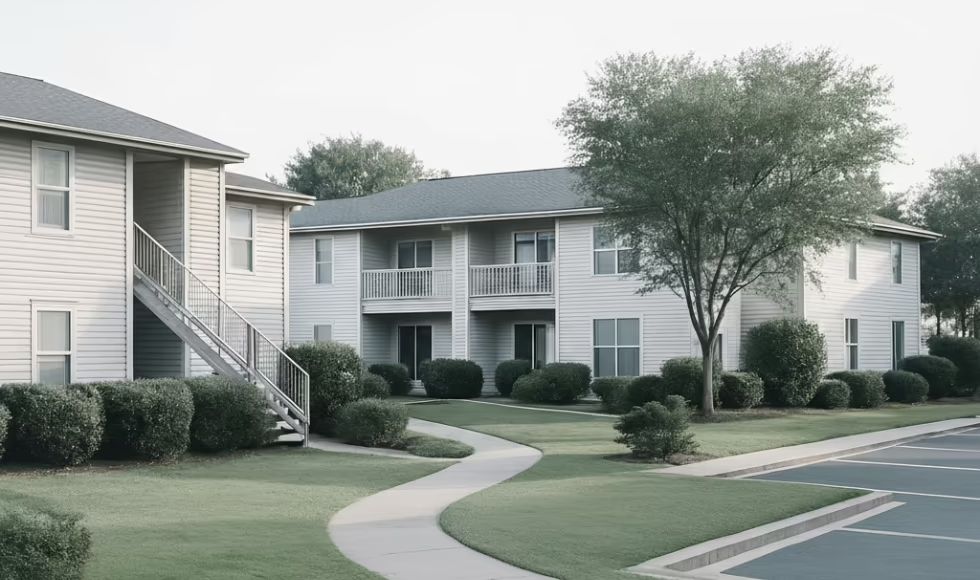
A German entrepreneur acquires a multifamily property in Florida. Instead of building an in-house management firm, he hires a professional property manager for day-to-day work: tenant relations, maintenance, accounting, vendor control. He retains the helm.
He owns asset management and the value drivers: prioritizing major renovations (e.g., kitchens and baths), setting the capex direction—such as converting unused areas into additional units—and negotiating with contractors, insurers, and lenders. He also defines the leasing strategy: target segments, pricing logic, marketing, concessions, reporting.
This is exactly what counts for E-2: an active, profit-oriented business with real operations and a clear managerial role. He is not a passive capital provider but a responsible manager—documented in the operating agreement, signing authority, and budget control.
The investment’s substance is clear: a multifamily asset with significant capital needs and planned capex programs. At the same time, stable cash flow emerges to support U.S. living costs. The investor unites two goals that reinforce each other: a return-capable asset in a growth market and a clean residence/work right for the family.
Mindset matters: you don’t need your own in-house management company to qualify—but you do need your hands firmly on the reins and documented decision authority in asset management.
As experienced partners, we’re at your side for such projects—practically and personally, because we’ve walked this path ourselves.
Upsides: Presence, Family, Structure
First, time. While Green Card routes often take years, a well-prepared E-2 can be realized within a manageable window.
That lets entrepreneurs form a U.S. entity or acquire an existing business and engage operationally—with real contracts, clients, and reporting—sooner.
Second, family. E-2 isn’t just for the principal. Spouses receive independent work authorization and aren’t limited to the investor’s company; they can take jobs, build their own business, or freelance. Children can live in the U.S., attend schools, and enroll at colleges until age 21. For many families E-2 is a Plan B that blends business agility with personal security—proven in day-to-day life.
Third, structure. Forming a U.S. company opens tax design space: entity choice, distributions, treaties, compensation—questions to answer professionally to improve liquidity, planning, and compliance.
With authorized status you may also obtain a Social Security Number (with work authorization), enabling a credit history. Settling in the U.S., you’ll benefit immediately: bank terms, leasing access, and business credit—good credit is everyday infrastructure, not a nice-to-have.
Risks: Dependence & Policy
E-2 is a business-based status. If the enterprise ceases to be viable or is shut down, the basis for residence ends. That isn’t a flaw; it’s the visa’s logic. It rewards activity, results, and leadership—and penalizes passivity. Choosing E-2 is choosing responsibility.
The second risk is policy. Visa categories are affected by political majorities and administrative interpretation; requirements and renewals can change. If you rely on E-2 long-term, plan scenarios, document conservatively, and keep your paperwork audit-ready: contracts, cash flows, decision paths, staff, insurance, financials.
Conclusion: Bridge Now, Anchor Later
The E-2 visa is a powerful way to enter the U.S. market lawfully while securing residence rights for your family. It’s more flexible and faster than pursuing a Green Card, yet it is clearly tied to an operating business.
Launching a venture together with Whitestone Capital can be your E-2 entry point. We’re happy to discuss it with you.