
The German real estate market is sending a signal at the start of the year that can no longer be explained away as a mere interlude. What was long categorized as temporary weakness is increasingly revealing structural characteristics. For investors, the question is therefore no longer just where interest rates are headed, but whether the model itself remains viable: can German real estate capital still generate reliable returns under these conditions at all?
A weak start to the year — and the recovery remains a claim for now
The German real estate market entered 2026 on a subdued footing. In the country’s key office markets, take-up in the first quarter totaled 616,800 square meters according to JLL, down around 17 percent year over year; BNP Paribas Real Estate reports 603,000 square meters across Germany’s major office hubs, a decline of 14 percent. This is not a market that is already back on solid ground. It is a market that is still struggling to regain breadth and momentum.
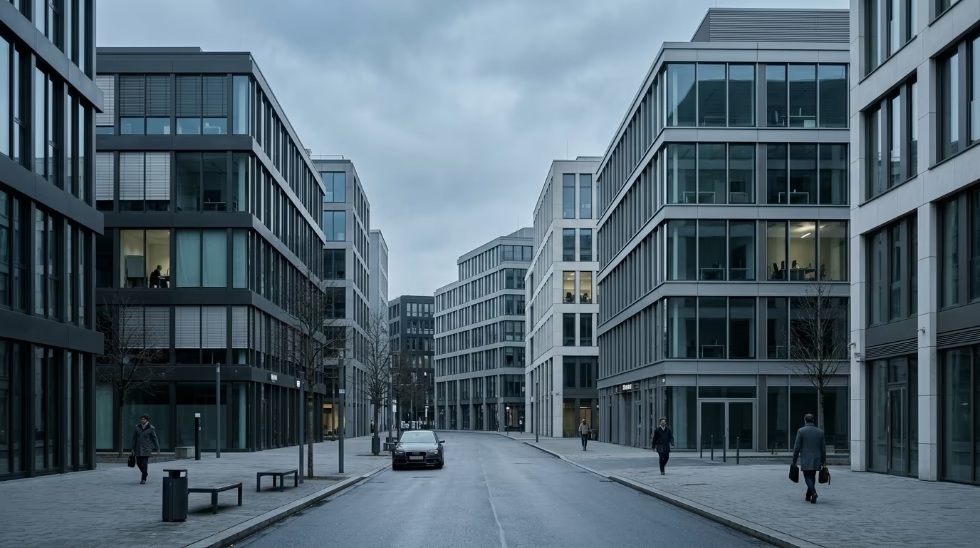
The investment side likewise still does not show the profile of a genuine rebound. In the German office investment market, BNP Paribas Real Estate recorded volume of €1.8 billion in the first quarter of 2026. That is 5 percent above the prior year, but still well below the long-term average. In the German residential investment market, Cushman & Wakefield reports €1.88 billion, 13 percent less than in the same quarter a year earlier; Savills comes in at around €1.6 billion, down 16 percent year over year and 36 percent below the ten-year average.
Anyone who already sees a durable recovery in these figures is currently reading hope more than market reality.
Three markets, one problem: the logic of returns is breaking down
In the office market, weakness is no longer merely cyclical. Hybrid work, remote work, and AI-driven efficiency gains are permanently reducing space requirements. Anyone expecting an automatic return to past demand patterns is mistaking hope for market logic. The only segment likely to remain durably investable is the small top tier: central, high-quality, ESG-compliant. Across large parts of the remaining stock, by contrast, pressure to repurpose is rising — and with it the need for capital.
At first glance, the residential market appears more stable, but arithmetically it is hardly more attractive. Even in Berlin, affordability limits are becoming visible. The issue no longer affects only project developers. It is now hitting traditional acquisitions of existing residential stock as well. Anyone buying today at 20 to 22 times annual rent is rarely acquiring a resilient cash flow.
What is often being acquired are buildings with deferred maintenance, outdated systems, and an ESG catch-up requirement that is regularly modeled too generously in due diligence. Realistic operating costs — management, maintenance, vacancy, insurance, and energy-related capex — depress returns far more than many offering memoranda suggest. On top of that come acquisition costs of around 15 percent. They increase invested capital, but generate no recurring income — and are typically not financed by the bank.
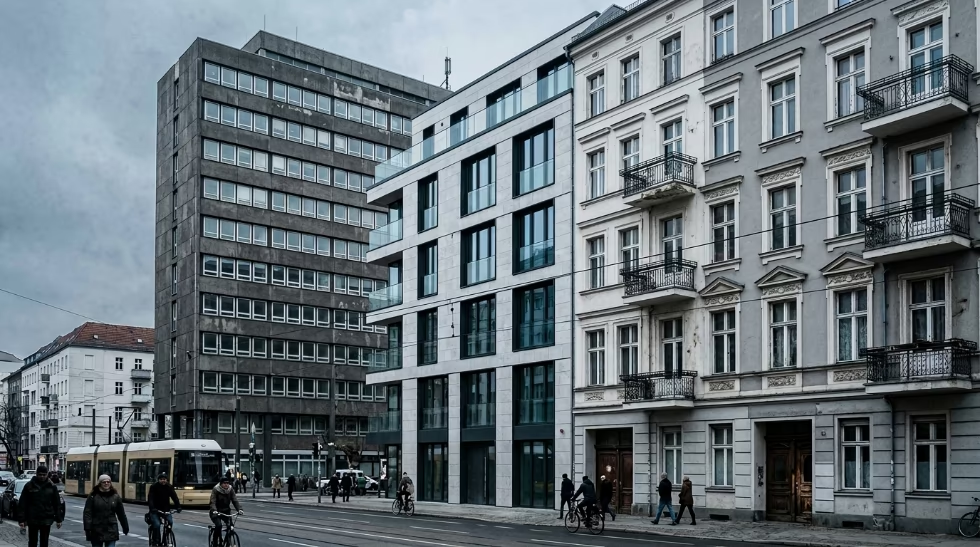
This is exactly where the return logic turns. Ongoing cash flow on invested equity quickly turns negative — even before a single euro is spent on genuine renovation work. And even at exit, profit does not begin with the first increase in value, but only once the acquisition costs have first been earned back.
Residential real estate in Germany is therefore becoming less and less of a yield asset for institutional investors and more and more of a bet on future appreciation — financed out of the present. That bet is becoming more uncertain at the same time. Politically constrained rent adjustments, narrowing owner discretion, and a macroeconomic backdrop without automatic repricing turn what appears to be a defensive asset into an investment that ties up a great deal of capital — while allowing less and less room for error.
| Item | Pessimistic | Optimistic |
|---|---|---|
| Purchase price multiple | 22x | 20x |
| + Acquisition costs (RETT 6.5% + notary/land register 2% + broker 6.5%) | + 15 % | + 15 % |
| Total investment | = 25.3× annual rent | = 23.0× annual rent |
| Gross initial yield (on total investment) | 3.95 % | 4.35 % |
| Operating costs (30–35%) | −1.38 % | −1.31 % |
| Net initial yield | 2.57 % | 3.04 % |
| Interest expense (debt 60.9% × 4.0% / 3.5%) | −2.43 % | −2.13 % |
| Principal amortization (debt 60.9% × 2%) | −1.22 % | −1.22 % |
| Cash flow after debt service (% of total investment) | −1.08 % | −0.31 % |
| Equity perspective | Pessimistic | Optimistic |
|---|---|---|
| Equity (30% of purchase price + 15% acquisition costs) | 45 % of total investment | 45 % of total investment |
| Cash flow on invested equity | −2.76 % | −0.79 % |
| Break-even: required appreciation | + 15 % | + 15 % |
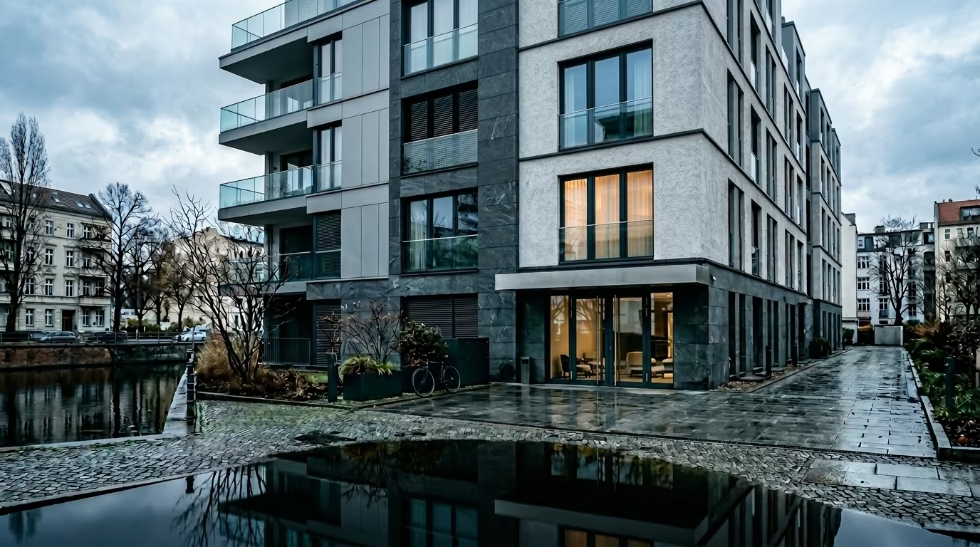
The yield calculation is therefore sobering: in both scenarios, ongoing cash flow on invested equity remains negative — and that is before any additional renovation or modernization costs. Exit does not begin with profit either, but first with catch-up work: before any value is created at all, the acquisition costs must first be earned back. In this model, that requires appreciation of around 15 percent.
Amortization is not a loss. It increases equity. From a liquidity standpoint, however, it remains an ongoing burden that has to be carried. Anyone unable to fund that gap from other sources is not holding a self-sustaining investment, but an asset that continuously ties up capital.
The macro backdrop is deteriorating not just perceptibly, but measurably
The pressure on the German real estate market is no longer an isolated sector issue. Germany’s economy grew by only 0.2% in real terms in 2025; for 2026, the institutes are currently forecasting 0.6% and have revised their forecast down by 0.6 percentage points versus autumn 2025. According to the Joint Economic Forecast, the energy price shock is dampening growth by roughly 0.3 percentage points in both this year and next. At the same time, manufacturing value creation, exports, and corporate investment are all being assessed more negatively than they were in the autumn.
That pressure is already visible in the labor market. In the fourth quarter of 2025, employment in Germany was 58,000 lower than a year earlier. While the public services, education, and healthcare segment added 212,000 jobs, the producing sector excluding construction lost 160,000. In manufacturing, the number of people employed fell from 7.413 million to 7.251 million in the 2025 annual average — a decline of 162,000. The problem, then, is not only weaker growth, but a shift in the composition of employment.
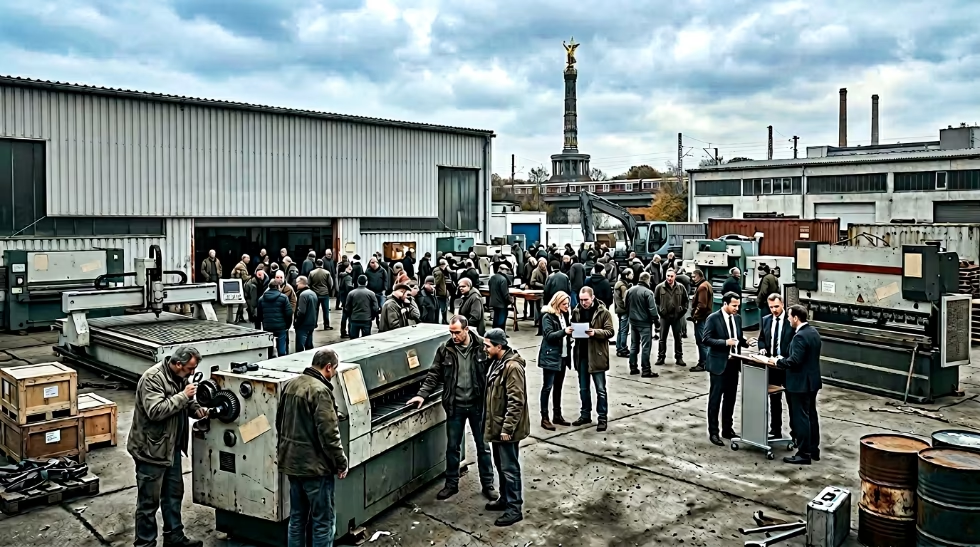
There is no sign of relief on the corporate side either. Creditreform counted 23,900 corporate insolvencies in Germany in 2025, up 8.3% year over year and the highest level in more than ten years. In the first quarter of 2026, the IWH recorded 4,573 insolvencies among partnerships and corporations — the highest quarterly figure in more than two decades. At the same time, according to the DIHK, 43% of industrial companies plan to invest abroad in 2026; 41% cite cost savings as the motive — the highest reading since 2003.
For the real estate market, this is not background noise. When industry, investment, and corporate dynamism come under pressure, the asset class that depends on precisely those fundamentals loses tailwind as well.
BauGB reform: a political signal, but no breakthrough
The federal government has responded to the crisis with an upgrade to the German Building Code (BauGB). The draft dated April 1, 2026 is intended to digitize planning procedures, simplify environmental reviews, shorten timelines, and give residential construction greater weight in tight markets. In planning law, an overriding public interest can be activated for this purpose; in conservation law, residential construction is to be explicitly designated as a compelling reason of overriding public interest. At the same time, municipal pre-emption rights are being expanded.
That sounds like political will. But it does not solve the core of the problem. The bottleneck in German housing construction is not the permitting process alone, but the combination of limited municipal capacity, high costs, weak development economics, and an environment in which private capital is becoming increasingly cautious. A reform that seeks to accelerate planning while simultaneously strengthening municipal intervention powers therefore does not send an unambiguously investor-friendly signal.
There is also the sheer scale of the problem. In 2024, only 251,900 homes were completed in Germany. Some industry-related forecasts for 2026 now speak of only around 215,000 completions — against a political target of 400,000 homes per year. At best, the reform is a step. The gap it is meant to close remains considerably larger than the instrument itself.
What this means for investors
German residential real estate is therefore not automatically a bad asset. But in 2026 it is an asset in an environment that systematically makes returns more difficult to achieve: according to the Joint Economic Forecast, after growth of just 0.2% in 2025, the German economy is expected to expand by only 0.6% in real terms in 2026; at the same time, the rent cap has been extended through the end of 2029, and the current BauGB reform strengthens municipal intervention powers in addition to accelerating procedures. For investors, that means more regulation, weaker growth, and a market that is becoming increasingly difficult to support from current income.
In the broader comparison, the framework conditions therefore currently argue much more clearly in favor of the United States. The IMF projects growth of 2.3% for the U.S. in 2026, a materially faster pace of expansion than in Germany. At the same time, the United States has been a net total energy exporter since 2019, while the IEA notes that electricity prices for energy-intensive industry in the EU were again more than twice as high in 2025 as they were in the U.S. For real estate capital, that is not a side issue: anyone investing in an economy that is growing faster and is more robustly positioned on energy is investing in a meaningfully stronger foundation.

There is also a political and regulatory difference on the rental side. While Germany continues to extend and deepen regulatory intervention, important Sun Belt states such as Florida prohibit local rent regulation outright, Texas allows it only in narrow exceptional cases with the governor’s approval, and Georgia prohibits municipal rent regulation as well. At the same time, Berkadia’s 2026 survey shows that the southeastern United States remains among the preferred regions for multifamily investors.
For investors seeking cash flow, operational control, and more market-based rent formation, this is not a detail but a structural advantage. The comparison is therefore not a polemic, but a sober prioritization of framework conditions. Germany in 2026 offers more political intervention, higher energy costs, and weaker growth. By comparison, the United States offers stronger macroeconomic momentum, a stronger energy position, and across large parts of the Sun Belt a more investor-friendly rental environment. Anyone allocating capital by return rather than by habit can scarcely ignore that difference.
Conclusion
German residential real estate is not worthless in 2026. But neither is it still the reliable standard product it was marketed as for so long. Anyone investing today is, in many cases, not buying robust cash flow, but high capital intensity, limited rental momentum, and a return expectation that increasingly depends on the exit rather than on current income.
That is precisely the strategic point: capital should not be tied up where regulation, costs, and the economic cycle all work against returns at the same time. It should be deployed where growth, market mechanics, and the owner’s position are more resilient.
The comparison between Germany and the United States is therefore not a question of style, but of capital discipline. Anyone allocating capital soberly in 2026 has to accept that proximity to home is not an investment case.