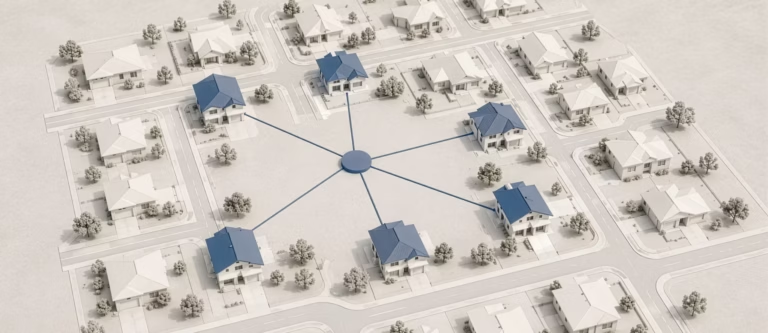


Why the escalation in the Gulf should be read not as a foreign-policy event for real estate, but as an energy, interest-rate and valuation risk.
Real estate is not a market that reprices overnight. Buildings are planned for decades, financing runs over long horizons, and development projects often tie up capital for many years. That is precisely why geopolitical crises can initially seem remote. In reality, however, they hit the sector at a particularly sensitive point: financing, costs and return expectations.
A prolonged conflict with Iran would not be a regional event in economic terms, but a global price shock. It would make energy more expensive, increase market uncertainty and shift capital flows. It is through these channels that geopolitics reaches the real estate market.
The link is not military, but economic. A war in the Gulf does not destroy buildings in Frankfurt or Dallas. But it does push up the cost of oil and gas. That makes transport, production, logistics, heating and, ultimately, large parts of everyday economic life more expensive. Companies pass on higher costs, consumers pay more, and an energy shock turns into broader inflationary pressure.
For real estate, that is decisive. When prices rise across the board, central banks come under pressure to respond. Rates then remain high or fall far more slowly than investors hope. For a market that depends heavily on debt capital and reliable underwriting, this is a direct source of pressure. Valuations come under strain, transaction volumes decline, and new projects become harder to underwrite.
The First Shock: Energy
A prolonged conflict in the Persian Gulf would begin not in the real estate market, but in the energy market. A significant share of global oil and LNG trade passes through the Strait of Hormuz. Anyone destabilizing this corridor puts pressure not just on one region, but on a central pricing anchor of the global economy. When risk rises there, energy prices rise immediately.
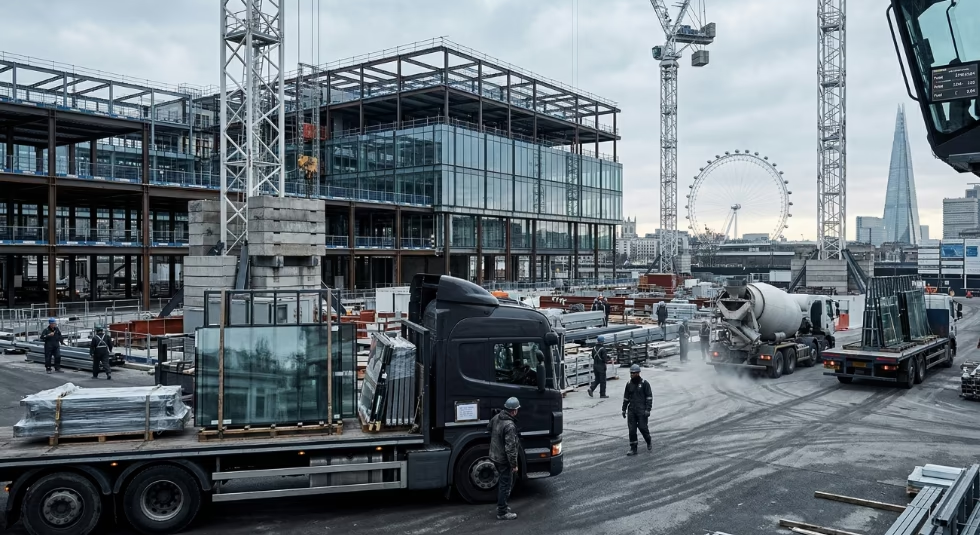
For real estate, this is the beginning of a chain reaction. Construction is one of the economy’s energy-intensive sectors. Steel, cement, glass, ceramics, insulation materials, transport and site logistics all depend, directly or indirectly, on the price of energy. When oil and gas become more expensive, not only individual inputs but entire project underwritings become more expensive. Projects that looked viable only a few weeks earlier lose margin, are delayed or no longer pencil out.
But the shock does not end on the construction site. It runs through the standing stock as well. Higher prices for heating, electricity and transport weigh on households as much as on businesses. Tenants are left with less disposable income, companies face higher operating costs, and financial flexibility declines on both sides. For real estate markets, this is sensitive territory, because it puts pressure not only on costs, but also on the resilience of demand.
Ultimately, the energy shock reaches monetary policy. When higher costs work their way through the economy, inflation remains an issue for longer. And when inflation proves stickier, interest rates stay higher for longer. It is precisely at this point that the real problem for real estate begins.
Interest Rates Are the Real Stress Test
Real estate markets rarely come under pressure because of a war itself. What matters is what it does to inflation, monetary policy and financing costs.
The value of a property is determined not only by its location or physical quality, but by the income it is expected to generate in the future. Those earnings lie ahead—and the higher the interest rate, the lower their value from today’s perspective. That is precisely why rising rates put valuations under pressure, even when nothing about the building itself has changed.

This hits real estate especially hard because the industry depends heavily on the price of capital. Acquisitions, refinancings and development projects all depend on credit markets. When money becomes more expensive, buyers underwrite more conservatively, projects lose cushion, and sellers struggle to adjust their expectations quickly enough. The market does not break all at once. It first becomes more sluggish, less liquid and materially slower.
In the short term, a geopolitical crisis can even trigger the opposite reflex in bond markets. Capital seeks safety, government bonds rally and yields fall. For real estate, that is usually only an interlude. When the conflict makes energy more expensive and broadens inflationary pressure, monetary policy stays tighter for longer. And that is exactly when a geopolitical shock becomes a real stress test for the property market.
Why Germany Would Be Hit Harder
Germany would likely be affected more severely by such a shock than the United States. The reason does not lie in a single risk factor, but in the structure of the market. The German real estate sector is heavily bank-based. Many acquisitions, refinancings and development projects depend on debt capital remaining available, affordable and predictable. It is precisely this precondition that comes under pressure in periods of geopolitical stress.
When money becomes more expensive and banks turn more cautious, the market is hit on several fronts at once. Developers lose financing headroom, investors underwrite more tightly, and transactions become more difficult. The market does not come to a halt, but it quickly loses momentum. Projects are postponed, business plans are recalculated, sales processes drag on, and a gap opens between buyers and sellers in which fewer and fewer deals get done.
On top of that, high energy prices hit the German market at a particularly sensitive point: the existing building stock. Many buildings are only moderately positioned from an energy-efficiency perspective, while demands for efficiency upgrades and refurbishment continue to rise. Energy thus becomes not only a cost factor, but also a valuation and regulatory risk. In a market with tighter margins and more cautious financing, that adds still more pressure.
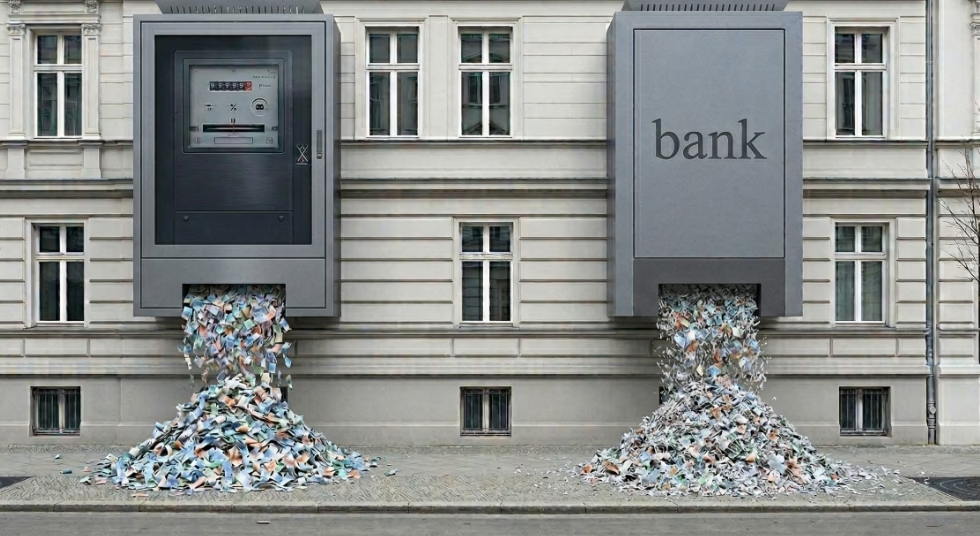
That is why a geopolitical shock would hit Germany not only at the macro level, but deep into the operational reality of the market. It is precisely this combination of credit dependence, risks in the existing stock and regulatory pressure that makes the German real estate market more vulnerable.
Why Crises Redirect Capital to the United States
Geopolitical crises do not redirect capital at random. They reward markets that are large, liquid and predictable. That is where the American advantage lies.
When uncertainty rises, global investors seek not only safety, but also the ability to act. They need markets where large volumes can be invested, reallocated or parked quickly, without their own scale becoming a problem. The United States offers exactly that: deep capital markets, high liquidity and a framework that remains comparatively stable even in periods of stress.
This applies not only to government bonds and equities, but also to real estate. Across many segments, U.S. property markets are easier for international capital to read, larger in scale and more readily transactable than many European markets. In periods of geopolitical uncertainty, that becomes a real advantage. Capital is not simply looking for yield. It is looking for a market that offers stability, scale and flexibility at the same time.
That is why the United States often benefits in times of crisis not despite global uncertainty, but because of its role as a safe and absorptive capital market.
Domestic Energy Is a Strategic Advantage
Another difference between Germany and the United States lies in energy production. The United States is not only a consumer, but also a major producer of oil and gas. That fundamentally changes the way an energy shock is transmitted.
High energy prices also weigh on the U.S. economy. But they hit a country that absorbs part of that shock within its own system. Where energy is produced, processed and exported, higher prices generate not only costs, but also additional revenues, investment and employment. That is exactly why regions such as Texas, Oklahoma or North Dakota can benefit economically in such an environment.
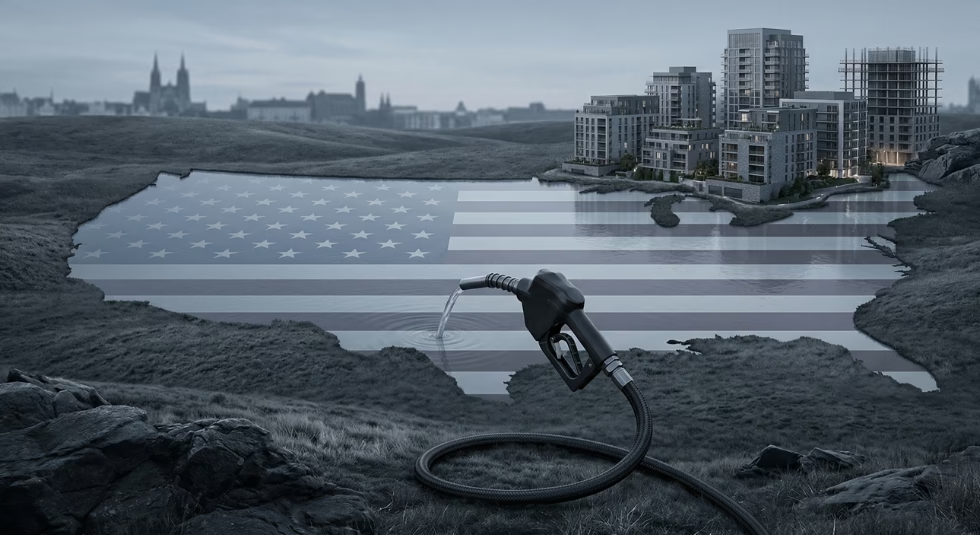
For the real estate market, that is an important distinction. Where investment in the energy industry increases, demand also rises for housing, logistics space, services and commercial property. Part of what is felt primarily as a burden in Germany can, in the United States, create additional regional demand.
That does not mean high energy prices would be positive for U.S. real estate across the board. But it does mean that the same shock is processed differently there: less as a one-sided cost problem, more as a combination of pressure and economic stimulus. That is precisely what makes the U.S. market more resilient than the German one in a geopolitical energy shock.
Conclusion
The question is no longer whether an Iran conflict would hit property markets. What matters now is how deeply the shock reaches into financing, valuation and the existing stock.
For Germany, that is bad news. A market that depends heavily on bank credit, sits on an energy-uneven building stock and operates under regulatory pressure reacts particularly sensitively to structurally higher energy costs and interest rates that stay elevated for longer. What still looked viable in calmer times can become too tightly underwritten in this environment.
The United States is not untouched by this. But it enters the same shock from a different market position: with deeper capital markets, greater liquidity and domestic energy production. That is precisely why the same geopolitical escalation is unlikely to spare U.S. real estate entirely, but will test German real estate much harder.
The core lesson for investors is therefore clear: in an environment like this, it is not the most spectacular assets that are rewarded, but the most resilient ones. What matters is financing headroom, energy profile, refurbishment capability and the question of how durable an asset remains when money stays expensive for longer.