

The popular conception of economics is often shaped by a fundamental fallacy—one that encourages poor political decision-making, stifles prosperity, and exacerbates social conflict. Although this line of thinking has been debunked for centuries, it continues to define the economic worldview of large segments of the population.
What is striking is how ideologically opposed actors agree on this exact point: both Donald Trump and the chairwoman of the Left Party in Germany, Heidi Reichinnek, implicitly argue using the same underlying pattern. Nearly one in two Germans shares this perspective.
This is known as the “zero-sum fallacy”—a mindset that interprets economic success fundamentally as a process of displacement. Psychologists Patricia Andrews Fearon and Friedrich M. Götz have empirically investigated this worldview. In an analysis of nine scientific studies across six countries involving approximately 10,000 participants, they demonstrate how widespread and consequential this thinking is.
They define zero-sum belief as a mental model of success where the success of others is automatically perceived as one’s own failure—and one’s own failure is seen as the success of others. The decisive factor is not whether a situation is objectively a zero-sum game. People with this mindset interpret even cooperative, growth-oriented situations as distribution conflicts—and align their economic and political behavior accordingly.
Why the Fallacy Seems Plausible
It is easy to understand why this view persists, as true zero-sum games do exist in life. Sports competitions are a classic example: for one team to win a football match, the other must lose.
Most economic interactions, however, follow a completely different logic. In the voluntary exchange of goods—trade—both parties benefit; otherwise, the exchange would never take place.
This is precisely where the zero-sum fallacy takes root. Fearon and Götz show that individuals with a pronounced zero-sum mindset systematically interpret these non-zero-sum situations as distribution battles, even when growth and mutual benefit are objectively possible.
This error does not remain theoretical. Those who perceive the world as a zero-sum game act accordingly: they advocate for isolationism, protectionism, and redistribution instead of allowing for cooperation, specialization, and growth. A protectionist economic policy is therefore often not a rational response to scarcity, but the logical consequence of a flawed worldview.

Rich Man and Poor Man
Zero-sum belief forms the ideological foundation of anti-capitalism. In this view, wealth is not the result of value creation, but the result of appropriation.
Bertolt Brecht famously articulated this thinking in his poem “Alphabet”:
“Rich man and poor man
Stood and looked at each other,
And the poor man said, pale and weak:
If I weren’t poor, you wouldn’t be rich.”
This is exactly how anti-capitalists imagine economic life. The prosperity of one is seen as the direct cause of the poverty of another. Wealth appears not as something created, but as something taken.
From this perspective, the demand for redistribution follows logically. If wealth is thought of as fixed, justice can only consist of distributing it differently. The fact that economic growth creates new value—and can thus produce winners without creating losers—does not fit into this moral framework.

A Historically Unprecedented Decline in Poverty
The zero-sum fallacy can be refuted simply by looking at historical reality. Before the advent of capitalist economic forms, the vast majority of the world’s population lived in extreme poverty. In 1820, the rate was around 90 percent.
Today, it has fallen to approximately 10 percent. The fact that this figure isn’t even lower is not due to a real deterioration in living conditions, but to a methodological adjustment: the World Bank has raised the international poverty line in recent years to better reflect current price and consumption data.
As a result, people are classified as “extremely poor” who would have been above the threshold under the previous definition. The long-term trend remains unaffected—it is statistically slowed, not realistically reversed.
Crucially, it is not just the massive decline in poverty that matters, but its coincidence with the rise in wealth. In recent decades, the number of billionaires worldwide has risen sharply, while at the same time, hundreds of millions of people have escaped extreme poverty.
This development fundamentally contradicts zero-sum logic. If wealth were truly only redistributed, more rich people would inevitably mean more poor people. Historical evidence shows the opposite: the economic “pie” has grown—and to an extent that was unthinkable in pre-modern societies.

The Example of China
Few countries refute zero-sum logic as impressively as China. Between 1958 and 1962, around 45 million people starved there as a result of the largest socialist economic experiment in history, the “Great Leap Forward” under Mao Zedong.
As late as 1981, a few years after Mao’s death, around 88 percent of the Chinese population lived in extreme poverty. The decisive turning point came not through redistribution, but through a break with the planned economy. In the early 1980s, Deng Xiaoping initiated market-oriented reforms, gradually opening the country to private initiative, property, and trade.
The result is historically unprecedented. Today, the proportion of the extremely poor in China is below one percent. Simultaneously, the number of billionaires has risen from zero to over 500.
This simultaneity cannot be explained by zero-sum logic. If wealth only arose at the expense of others, the rise of a wealthy elite would inevitably have generated new poverty. Instead, the opposite happened: as economic freedom grew, overall prosperity increased—and poverty vanished at a pace unique in human history.

Does Wealth Only Come at the Expense of Others?
The notion of trade as a zero-sum game is also false. As early as the 18th century, the Scottish economist Adam Smith recognized that voluntary exchange does not merely shift existing wealth, but creates new wealth. The decisive mechanism is specialization and the division of labor: when individuals, companies, or countries concentrate on what they can do relatively best, total production increases. Trade is then not a fight over a fixed pie, but a process by which the pie becomes larger.
This insight was further refined by the economist David Ricardo. With his theory of comparative advantage, he showed that trade is beneficial even if one country is less efficient in all areas than another. The decisive factor is not absolute performance, but the relative comparison between different activities.
A simple practical example illustrates the principle: suppose Country A can produce both cars and textiles more efficiently than Country B. Trade is still worthwhile. If Country A is exceptionally productive with cars but only slightly superior with textiles, while Country B is poor at textiles but significantly less inefficient there than with cars, then it makes sense for both to specialize. Country A focuses on cars, Country B on textiles. Through subsequent trade, both countries end up with more cars and more textiles than if each had tried to produce everything themselves.

This is the essence of comparative advantage. A country does not have to be “the best” at something to benefit from trade. It is enough to specialize in those activities where its disadvantage is smallest compared to other options. Resources are thus used more productively, the total quantity of available goods grows, and additional prosperity is created.
Trade thus enlarges the economic “pie” rather than just re-dividing it. Zero-sum logic—where one’s gain is necessarily another’s loss—is incompatible with this reality. Value creation arises not through displacement, but through cooperation.
The Roots of Zero-Sum Belief – Why It Seems So Plausible
Psychologists Fearon and Götz describe zero-sum belief as a generalized belief system that is not limited to economics but unfolds particularly harmful consequences there. In its basic form, a zero-sum game describes a situation where one person’s gain inevitably means another’s loss. The total value remains constant.
Economic growth, however, usually follows a different logic. In so-called non-zero-sum games, the total amount is not fixed. Through innovation, division of labor, and trade, additional value can be created, allowing multiple parties to benefit simultaneously. It is exactly this distinction that is lost in zero-sum thinking.
Imagine a small village community. There is only a limited amount of land, food, and tools. If one person gets more, there is inevitably less left for others. In such a world, it is logical to be suspicious. Wealth there is usually not created by new ideas, but by power, violence, or deceit. Whoever has more often has it at the expense of others.
Zero-sum belief originates from precisely such living conditions. For millennia, growth was barely visible. Technical progress was so slow that an individual could hardly perceive it in their lifetime. The world appeared as a closed space with fixed boundaries. Under these circumstances, it was rational to interpret economic advantages as displacement.

The problem is: this mindset has been carried into the 21st century.
In a modern market economy, however, the economy functions fundamentally differently. Prosperity arises not primarily through redistribution, but through productivity, division of labor, innovation, and trade. When someone develops a better product, works more efficiently, or satisfies new needs, additional value is created. The pie gets larger. No one has to become poorer as a result.
Nevertheless, many people continue to think as if they were living in that ancient village. Every gain seems suspicious. Every wealthy person appears as someone who must have taken something from others. Growth is not perceived as a real possibility, but as a rhetorical trick.

Economist Paul H. Rubin describes this thinking as “folk economics.” In this everyday popular view, the focus is almost exclusively on distribution: Who has too much? Who is getting too little? How must it be redistributed? The question of how prosperity is actually created plays almost no role.
This is the core of zero-sum belief. Those who instinctively understand economics as a struggle for distribution ignore value creation. Everything revolves around justice within a pie that is assumed to be fixed. The idea that this pie can grow does not fit the mental model. Growth then feels like a threat rather than an opportunity.
And from this fallacy arise political demands, fears, and resentments that may seem rational—but are not.
Why Technology, Machines, and AI Trigger Fear: The Belief in "Fixed Jobs"
In the popular conception of the economy, jobs are seen as a fixed quantity. If one person gets a job, another must lose one. Labor is treated as a finite good, similar to land or money in a closed community.
It is from this thinking that technical progress is perceived as a threat. Machines, automation, or new technologies do not appear as means to increase productivity, but as competitors for a supposedly fixed number of jobs.
This fear is not new. As early as the beginning of the 19th century, so-called Luddites destroyed looms and other equipment because they believed machines were taking away their work. The logic was simple: if machines produce more, fewer people are needed—therefore, people lose their livelihoods.
The same logic confronts us today. Robots, software, and Artificial Intelligence are perceived as job killers rather than tools. The underlying idea remains the same: that there is a fixed amount of work that can only be redistributed.

What this thinking overlooks is the crucial point: technical progress does not destroy work itself, but transforms it. Productivity gains lower costs, enable new products, create new needs, and open up new activities. This is precisely why the number of jobs has historically not shrunk but grown—despite, and indeed because of, increasingly powerful machines.
The fear of technology is therefore not a rational reaction to real scarcity, but the consistent consequence of a zero-sum worldview. Those who view labor as a fixed pie must fear every increase in efficiency. Those who understand growth recognize efficiency as a prerequisite for prosperity.
Our Brains Are Not Accustomed to Growth
Zero-sum belief is not just a political or ideological phenomenon; it is deeply rooted in human cognition. Economist Paul H. Rubin explains it through evolutionary biology. For hundreds of thousands of years, humans lived in a world with almost no economic growth and only very slow technological change. The pace of progress was so low that an individual could hardly perceive it in their lifetime. To the human brain, the world therefore appeared stable, limited, and largely immutable.
The division of labor was also highly restricted. It was essentially confined to biologically defined roles, particularly between men and women, and between children and adults. Men typically handled hunting, defense, and tool-making, while women gathered, cared for children, and organized daily life. Beyond this, specialization in the modern sense hardly existed. There were no distinct professions, no complex production chains, and no systematic division of labor to increase productivity.
Trade also played only a minor role. It was not a permanent system for increasing efficiency, but usually an occasional exchange of surpluses—someone had an excess of something that another person happened to need. Economic progress rarely resulted from this. Growth as a conscious goal was practically unknown.
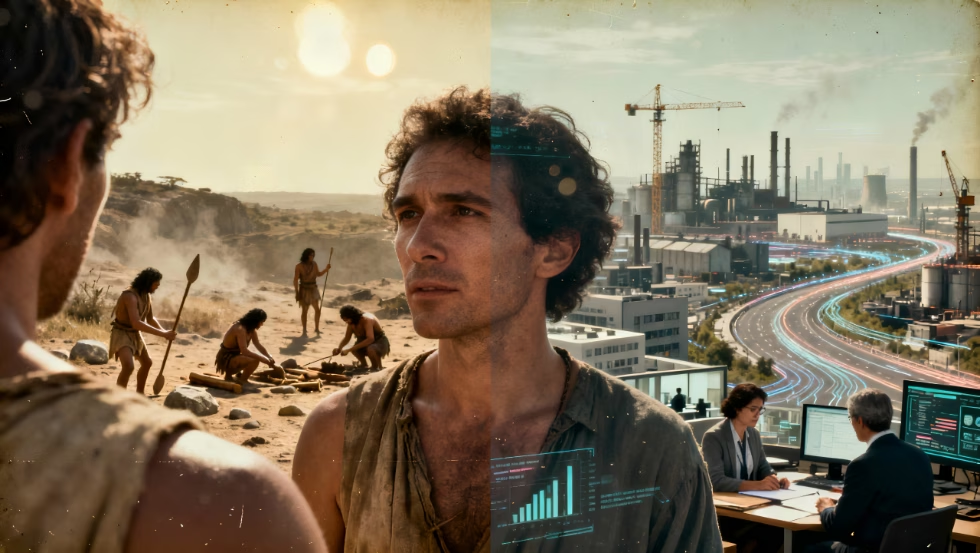
Under these conditions, differences in wealth were often indeed based on one person outmaneuvering another, taking something away, or exercising power. Whoever had more often attained it not through innovation or productivity, but through social dominance or unfair exchange. In such a world, mistrust was rational. It paid to be sensitive to injustice and possible exploitation.
From this environment, a strong human sense of fairness, envy, and distribution developed. This mental model was useful for millennia—and is deeply embedded in the human brain. The problem arises when this ancient thinking pattern is transferred unchanged to modern market economies. Our brains are adapted to a world without growth, while our economy operates according to a logic of permanent growth. The resulting contradiction explains why economic progress is often intuitively perceived as a threat, even though it has historically been the primary driver of prosperity.
The Fallacy of Distribution
In pre-capitalist societies, it was plausible to view wealth as something fixed that could only be redistributed. Wealth there rarely arose from productive value creation, but predominantly through power, violence, and political privilege. A classic example of this is the feudal system of the Middle Ages.
Lords, nobility, and clergy appropriated the bulk of economic returns without being productively active themselves. Peasants worked the land, craftsmen produced goods, but a significant portion of the returns was siphoned off in the form of taxes, tithes, and corvée labor. This wealth was not invested to create new productivity, but was often consumed for wars, palaces, courts, or luxury. For the vast majority of the population, the wealth of the rulers meant quite literally: less food, less security, less freedom.
In such an order, prosperity was indeed a zero-sum game. If the lord had more, less remained for the subjects. There was little technological innovation, few productivity gains, and almost no social mobility. Those who were rich stayed rich; those who were poor stayed poor. The wealth of some was based directly on the exploitation of others.
This historical pattern of experience continues to shape thinking today. If prosperity has been experienced for centuries as the result of oppression, it seems logical to view it as something that can only be distributed, not created. Under those conditions, zero-sum belief was not an error, but a realistic description of the circumstances.
The market economy system breaks exactly with this logic. Economic growth makes it possible for the first time for some people to become very wealthy without others having to become poorer as a result. Prosperity no longer arises primarily through siphoning off, but through ideas, innovation, and the satisfaction of needs.
A modern example of this is Brian Acton and Jan Koum, who developed WhatsApp and sold it to Facebook for $19 billion in 2014. Billions of people today benefit from free communication. The founders became extremely wealthy without making anyone poorer. Inequality was created, but not impoverishment.

Terms like “distributive justice” often fail to recognize this fundamental difference. They transfer mental models from a feudal world of extraction to a market world of value creation. Economist Ludwig von Mises therefore fundamentally rejected the idea of a separation between “production” and “distribution.” In a market economy, goods do not emerge ownerless, only to be distributed afterwards. They are created as property from the beginning. Anyone who wants to distribute them must first confiscate them.
The decisive point is thus clear: zero-sum belief was historically understandable because prosperity was indeed based on exploitation for a long time. In modern market economies, however, it is a cognitive error. Those who continue to view the economy through the lens of lords and subjects fail to recognize how prosperity is created today—and why it can grow without anyone having to become poorer.
Why Zero-Sum Belief is Toxic
Zero-sum belief is not without consequences. Those who view the economy as a struggle for distribution over a fixed pie systematically overlook the fact that every redistribution has repercussions on the size of that pie. Interventions then appear morally imperative, even if they stifle investment, destroy performance incentives, and prevent growth. The result is paradoxical: one redistributes more and more aggressively—and ends up with less and less to distribute.
Or, as Bodo Schäfer pointedly put it: if you keep redistributing further and further, eventually no one has anything left.

This thinking is not only economically incorrect, but socially toxic. It shifts the focus away from value creation and toward blame. Instead of asking how prosperity arises, the dominant question becomes: who can we take something from? Growth is not perceived as a solution, but as a grounds for suspicion.
The fact that this logic is widespread is shown by a qualitative study by sociologist Patrick Sachweh on patterns of interpretation regarding social inequality in Germany. Many people implicitly understand the economy as a zero-sum game. In their mental model, there exists only a limited number of privileged positions or a fixed amount of wealth. If some are doing better, others must inevitably be doing worse.
Within this worldview, inequality is automatically interpreted as injustice. The success of individuals is seen not as the result of performance, innovation, or entrepreneurial risk, but as evidence of the structural disadvantage of others. Whoever wins must have displaced someone. Wealth appears not as a signal of value creation, but as a moral problem.

From this logic, envy inevitably arises—but an envy that disguises itself as virtue. The wish for others to be worse off then appears not as resentment, but as a commitment to justice. This is precisely what makes zero-sum belief so dangerous: it moralizes economic relationships and poisons social discourse.
The toxic core of this thinking lies in the fact that it systematically attacks prosperity while claiming to create justice. Those who only ever redistribute without protecting the conditions for value creation eventually destroy exactly what they want to distribute. Zero-sum belief thus leads not to more fairness, but to general impoverishment—both economically and mentally.
At the World Forefront of Envy: Germany and France
Zero-sum belief forms the mental breeding ground for envy and resentment toward the wealthy. Those who assume that the prosperity of some inevitably comes at the expense of others must see wealth as a problem. The fight against poverty then appears logically as a fight against the rich—and redistribution as a moral duty.
That this connection is not a theoretical construct is shown by international survey data. In a survey by the polling institutes Allensbach and Ipsos MORI across 13 countries, researchers examined how people think about wealth and the wealthy. Several questions were used as indicators of social envy. Envy was deliberately defined strictly: as the wish that the rich should be significantly worse off, even if one’s own situation does not improve as a result.
The result is clear. Social envy is most pronounced where zero-sum belief is particularly widespread. France and Germany are at the top. In countries like Poland, Japan, or Vietnam, the proportion of envious people is significantly lower.

These differences are no coincidence. Societies in which economic success is reflexively interpreted as the result of exploitation generate mistrust and resentment. Where wealth is seen as a moral problem, envy is socially legitimized. Zero-sum belief transforms a destructive emotion into a seemingly just stance.
This is where its social volatility is revealed. Envy is no longer perceived as a personal feeling, but as a political argument. The desire for redistribution is then fed not by the goal of reducing poverty, but by the impulse to punish wealth.
“It’s Always Others Who are Envious” – Self-Deception and Blame
Zero-sum belief can be clearly measured empirically. In international surveys, respondents were presented with the statement: “The more the rich have, the less is left for the poor.”
In Germany, a relative majority of 48 percent agreed with this statement, while 44 percent rejected it. Germany is thus among the countries where zero-sum belief is particularly widespread.
The picture becomes even clearer in an East-West comparison. In East Germany, nearly 60 percent of respondents agreed, while only 29 percent rejected it. In West Germany, approval was significantly lower and clearly below the East German value. Zero-sum belief is less firmly anchored there.
These differences are not mere statistical details but have political and social consequences. People who agree with the zero-sum statement interpret economic relationships fundamentally as a process of displacement. Wealth appears to them not as the result of value creation, but as proof that something was taken from others.

Correspondingly, scapegoat thinking is pronounced. 63 percent of those who hold zero-sum beliefs see the rich as guilty of the world’s major crises. Among those who reject the zero-sum statement, the figure is only 36 percent.
The connection is particularly clear on the subject of envy. In Germany, 84 percent of social enviers agreed with the statement “The more the rich have, the less is left for the poor.” Only 14 percent contradicted it. Among non-enviers, the opposite picture emerged: only 28 percent agreed, while 68 percent rejected the statement.
The mechanism behind this is simple. If you believe that wealth only arises through taking, envy becomes logical and rational. The wish for others to be worse off then appears not as resentment, but as a commitment to justice. Simultaneously, envy is almost always denied. Hardly anyone describes themselves as envious. Instead, the feeling is morally relabeled—for example, as a concern for “social justice.”
The decisive point is therefore not moral, but cognitive. Social envy is not a character trait, but the consistent consequence of a flawed economic worldview. Those who understand economics as a zero-sum game can hardly perceive wealth as anything other than unjust.
What Does This Have to Do with the USA? Mentality, Growth, and Lower Political Risk
Zero-sum belief explains not only economic policy errors but also deep-seated cultural differences between societies. This is particularly evident in a transatlantic comparison. Where economic success is reflexively interpreted as the result of exploitation, mistrust, envy, and political deadlock arise. Growth is seen there not as an opportunity, but as a threat.
Those who are successful are under pressure to justify themselves; those who fail look for someone to blame.
The United States—despite all its obvious problems—functions differently mentally. Success there is predominantly understood as the result of ideas, risk-taking, and personal effort, not automatically as proof that something was taken from someone else.

The basic social impulse is less “Who has too much?” and more “How can I build something myself?” This reduces envy, increases the acceptance of inequality, and creates a cultural environment in which innovation is not permanently politically delegitimized.
This mental difference has real economic consequences. Entrepreneurial dynamism, technological breakthroughs, and capital formation occur in the US regularly faster than in highly redistribution-oriented societies. Not because Americans are morally superior, but because zero-sum belief is less deeply anchored there.
Where success is not automatically seen as a moral problem, it is also not systematically combated. For investors, entrepreneurs, and high-performers, this is decisive. Less envy means lower political risk. Less resentment means higher planning certainty. A culture that understands economic processes as a non-zero-sum game generates more stable framework conditions than any well-intentioned redistribution logic.
In short: America is not free of problems. But it is largely free of the idea that prosperity inevitably comes at the expense of others.
It is precisely this mental difference that explains why economic dynamism, innovative power, and capital formation repeatedly emerge there—while other societies remain stuck in the struggle over a supposedly fixed pie.