
Working with family offices has changed the way we think about real estate investing.
Not because smarter decisions are inherently made there. Substantial wealth does not protect against misjudgment either. The difference lies elsewhere: an investment has to fit within a structure that extends far beyond the individual asset.
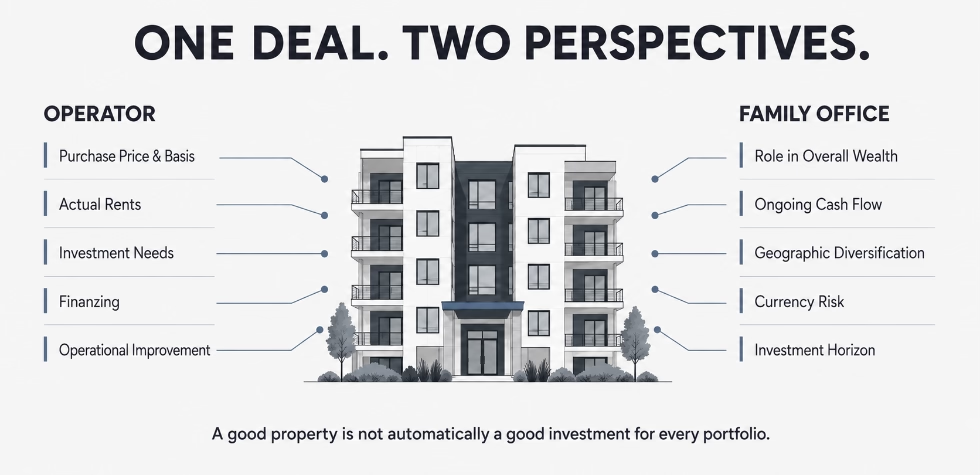
For us as an operator, that has been an important lesson. We naturally evaluate a multifamily property in Florida up close: What does the property cost? What rents are actually being collected? What capital expenditures are required? How is it financed? What can be improved operationally?
A family office looks at the same deal from a greater distance. Not more superficially, but in a different context. The investment is expected to serve a specific purpose within a pool of wealth that may have been built over decades and is intended to support multiple generations.
The individual deal still matters. It is simply never the only consideration.
There Is No Standard Family Office
The term suggests more uniformity than exists in practice.
At one end are professionally built organizations with in-house specialists in real estate, private equity, capital markets, tax and legal. At the other is a single trusted adviser who has coordinated a family’s key wealth matters for many years. Almost every conceivable structure exists in between.
For many entrepreneurial families, a family office does not begin with a formal resolution. Responsibilities first grow within the existing operating company. The CFO handles real estate alongside the core job, in-house counsel oversees investments, and a long-standing employee keeps an eye on banking relationships and contracts. Only as the wealth becomes more substantial—or when the structure needs to be fundamentally reorganized after the sale of a business—does a standalone organization emerge.
Other families use a multi-family office. Still others have developed structures over generations that operate with the professionalism of an institutional investor.
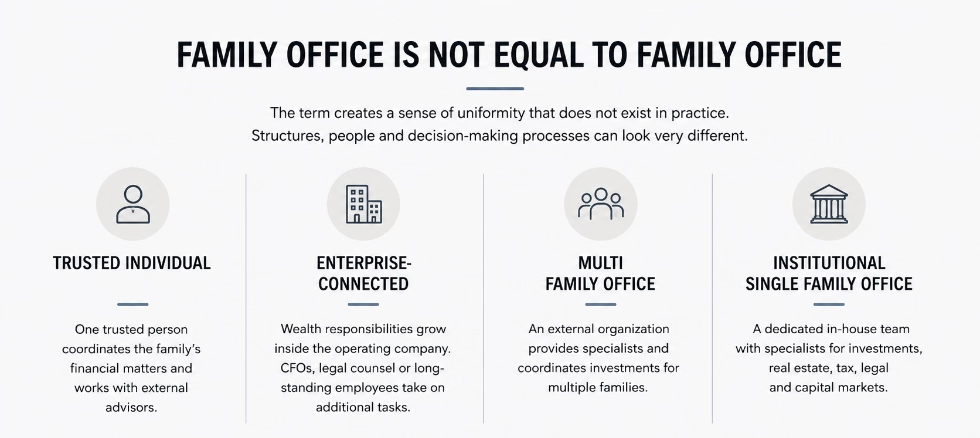
Conversations vary accordingly. Sometimes we sit across from dedicated real estate professionals who scrutinize every assumption in the business plan. Sometimes a single person prepares the decision for the family. In other cases, the wealth owners, an advisory board, tax advisers and external investment advisers are all involved.
The label “family office” therefore tells you very little on its own about the people, processes and responsibilities on the other side of the table.
Substantial Wealth Raises Different Questions
For private investors, the conversation often begins with expected returns. Family offices care about returns too, of course. An investment with an unattractive risk-return profile does not improve simply because it sits within a professional structure.
But return is rarely considered in isolation.
A family office wants to know what role an investment is meant to play within the existing wealth structure. Is it intended to generate current income? Is the priority long-term capital preservation? Does it reduce geographic concentration? Does it introduce new currency risk? How long will the capital be tied up? How does the investment interact with existing real estate holdings and operating-company interests? Is it compatible with the family’s multigenerational time horizon?
Certain fundamental questions are similar across borders: How can wealth remain resilient over the long term? Which risks should be taken deliberately? Where are local partners necessary? The answers, however, remain shaped by the family’s origin, legal jurisdiction and structure.
Substantial fortunes are often built through concentration. An entrepreneurial family did not succeed for decades by spreading capital as broadly as possible across arbitrary investments. It understood a product, an industry or a market better than others.
After the sale of a business, that starting point changes fundamentally. An operating asset the family understood and controlled becomes liquidity that must be redeployed. Expertise in the family’s own business does not automatically transfer to international real estate, private equity funds or other asset classes.
Capital can become liquid overnight. A resilient investment organization cannot be built just as quickly.
For us, an apartment community in Florida may be the focus of our daily work. For the family, it may be one of twenty positions that together are meant to create a resilient long-term portfolio.
A good asset is therefore not automatically a good investment for every family.
Discretion Begins With Restraint
In the world of substantial wealth, trust is discussed constantly. The word is used so often that it can quickly lose any concrete meaning.
Our experience is more prosaic: trust first shows up in how information is handled.
A family office does not need to disclose the family’s entire balance sheet to a real estate partner. It does not need to explain what other holdings exist, what reserves are maintained or how succession is structured within the family if those details are not relevant to the specific investment.
Not everything that might interest a business partner is information that partner needs to know.
This distinction becomes especially clear in financing. A family may use debt even if it could theoretically fund the acquisition entirely from its own resources. In that case, financing is not a necessity but a strategic decision within the capital structure. Treating that situation like a conventional loan application may lead to the wrong questions and requests for information that are not needed for the transaction itself.
Discretion therefore means more than keeping information confidential once received. It also means limiting one’s own curiosity.
At the same time, discretion cannot be an excuse for opaque investments. An operator needs to know little about the family. It needs to be exceptionally clear about the property, financing, costs, risks and status of the business plan.
Professionalism Does Not Mean Doing Everything In-House
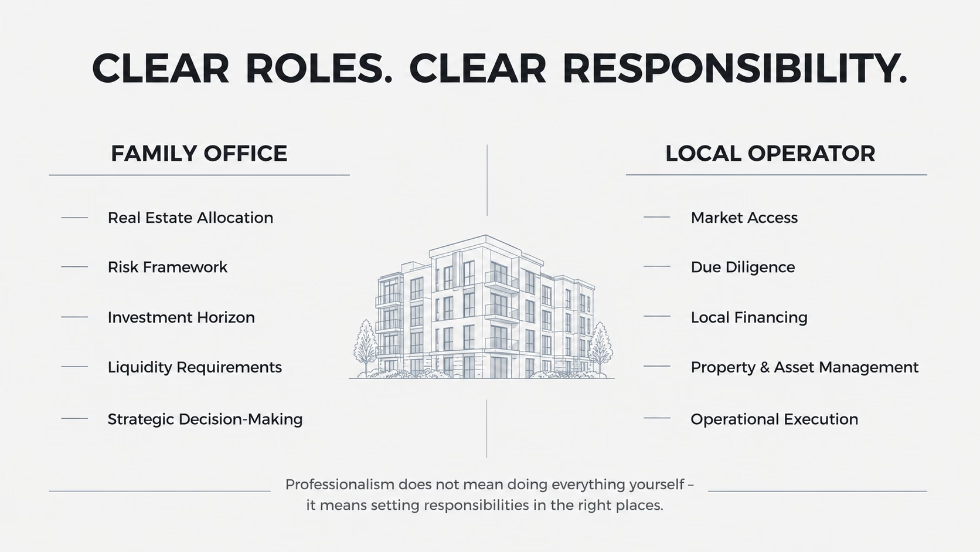
From the outside, it is easy to assume that a professional family office should employ in-house specialists for every asset class. In large organizations, that is sometimes the case. But there are equally professional wealth organizations that deliberately operate with lean teams.
More people do not automatically create more control.
An organization can grow to the point where a meaningful share of its energy is spent managing its own specialists. At the same time, a small team cannot cover every market, region and operating nuance on its own.
The critical capability is therefore not doing everything internally. It is knowing which decisions must remain in-house and where outside expertise adds value.
A German family office can determine for itself what share of its wealth should be allocated to U.S. real estate. It can define acceptable risks, how long capital may be committed and what level of current income is expected. It does not need to build its own operating platform in Florida to do so.
Local market knowledge cannot be replicated from a distance. The same is true of access to suitable assets, oversight of property management, supervision of renovations, discussions with local banks and the ongoing assessment of a submarket.
That limitation actually makes collaboration easier. A family office does not need another provider claiming to solve every question across the family’s wealth. It needs dependable specialists for clearly defined responsibilities.
Reporting Is More Than Numbers
Working with family offices has also changed how we think about reporting.
A report can be complete and still explain very little. Occupancy, rental income, operating expenses and renovation progress can all be presented in tables. The harder part begins when actual performance diverges from the original plan.
At that point, it is not enough to know that a metric came in below expectations. What matters is why it deviated, whether the cause is temporary or structural, and what follows from it. Lower occupancy may be accepted deliberately while unprofitable leases are allowed to expire and units are renovated. But it may also point to weaker demand, incorrect pricing or problems in property operations.
The number is the same. Its meaning is not.

Rents are similar. A unit may technically be leased even when payments are delinquent or substantial concessions were granted. The reported occupancy rate can therefore look stronger than actual cash flow.
A good report focuses on what has changed since the previous reporting period. It separates normal volatility from developments that affect the business plan. It does not conceal problems until they become impossible to ignore.
This is not a special expectation unique to substantial wealth. It is simply sound asset management. Family offices tend to insist on it more consistently.
Optimism Does Not Strengthen an Investment Case
Every investment pitch has a natural bias toward optimism. The market is growing. The location is attractive. The property has upside. Units can be renovated, rents can be increased and operating costs improved. Under the assumed conditions, the result is a compelling return.
All of that may be true. But it describes only one possible path.
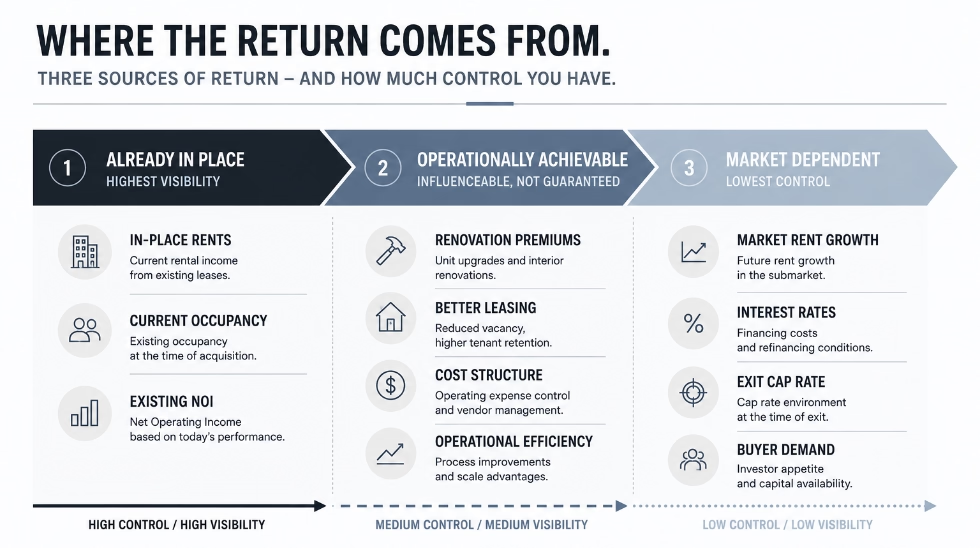
What has become more important to us is drawing a clearer distinction between what exists in the asset today and what the business plan expects to achieve. What income is already in place at acquisition? Which improvements still have to be delivered? Which assumptions depend on the market? Which can we influence operationally? Where is the plan most sensitive?
Financing is one example. Lower leverage can make a business plan more resilient, but it often limits equity returns. Higher leverage can enhance returns when the plan works while reducing flexibility if cash flow weakens. The point is not to declare one structure universally right. The point is to make the trade-offs clear.
The same applies to the eventual sale. No one knows today what cap rate will prevail when a property is sold several years from now. A model that works only under an especially favorable exit is not conservative underwriting.
An investment memorandum is not strengthened by the highest projected return. It is strengthened when the reader can see which assumptions are robust and how much cushion remains if the market does not cooperate.
The same applies to the economic alignment among the parties. How much of its own capital does the operator invest? Which fees are earned regardless of performance? Who decides if additional capital is required? What options exist if the original plan does not work?
Family offices do not expect every risk to be eliminated. That would be unrealistic. But they do want to understand where the risks are, who bears them and how early they become visible.
Trust Is Built When Things Get Difficult
At the outset of an investment, interests are easy to align. The business plan is plausible, expectations are positive and the market appears manageable.
The real value of a partnership becomes clear later.
Markets change. Insurance gets more expensive. Financing develops differently than expected. Renovations take longer. Tenants do not respond exactly as a model assumes.
In those situations, trust is not built through reassuring language. It is built by raising problems early, explaining the causes and making decisions transparently.
Family offices are not fundamentally different from other investors in this regard. Their long-term orientation and internal decision-making structures, however, make them particularly sensitive to gaps between presentation and reality.
A mistake can be explained. An unexpected market development can be put in context. It becomes more difficult when information is delayed, incomplete or shared only reluctantly.
A partner does not need to be right every time. It needs to remain dependable when the original assumption no longer holds.
What Has Changed in the Way We Work
Family offices are not a homogeneous investor segment. They differ significantly in origin, size, organization and decision-making processes.
What they share is a responsibility that extends beyond any individual investment. Capital must do more than be invested. It must fit within a long-term structure, be explainable internally, and remain resilient under changing conditions.
Working with family offices has sharpened how we view our own role. In reporting, we do not stop at the numbers; we explain what has changed and what follows from it. We draw a clearer line between existing cash flow and expected upside. We assess not only the asset, but also the structure in which it is held and financed. We see ourselves as specialists, not advisers on every aspect of substantial wealth.
Perhaps that is the most important lesson: substantial wealth does not inherently require more complicated investments. It requires clearer responsibilities, more robust assumptions and partners who do not overstate their own role.
Whitestone does not make decisions about a family’s overall wealth. Our role is more clearly defined: we take responsibility for the part of the real estate allocation we can actually assess, execute and manage on the ground.
With substantial wealth in particular, that limitation is not a weakness. It is a prerequisite for a dependable partnership.