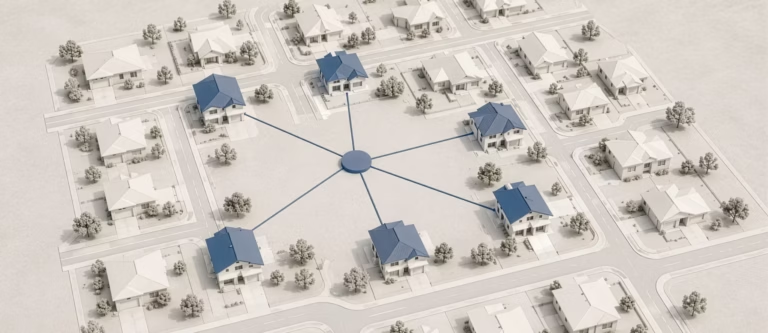

The offering memorandum, rent roll and operating statement show the seller’s numbers. Once ownership changes, several of them change with it in Florida: property taxes, insurance and the amount of cash that is actually available. An interim report from one of our properties.
When Whitestone Capital acquired a Florida apartment community together with a family office at the end of October 2025, the roofs were first on the list. Several were leaking, and early moisture damage was already visible. The lender had also issued a schedule of required work: items to be completed within the first 90 days and others due over the first few years.
By February 2026, the roofs and gutters had been replaced and the urgent repairs completed. The grounds were next. Occupancy stood at approximately 84% at acquisition and approximately 96% in February. The business plan assumes an average of 93% for the first year; whether that annual average is achieved will only be clear at year-end.

The business plan contains a budget. On site, the work still has to be organized around ongoing leasing operations.
Those are the visible improvements. Less visible is what changed in the numbers when ownership changed.
German investors can easily underestimate this distinction because a sale in Germany neither triggers a new property tax assessment nor terminates the building insurance; under the German Insurance Contract Act, the policy even transfers automatically to the buyer. Florida treats both differently.
We discussed how we test assumptions before an acquisition in our article on off-market opportunities and due diligence. This article addresses what comes next.
The New Property Tax Arrives Nearly a Year Later
Florida caps annual growth in the assessed value of residential property with ten or more units: for all levies other than school district levies, the increase may not exceed 10% per year. If an owner holds a property for many years while market values rise faster, its tax basis can eventually sit well below market value.
That gap benefits the seller, and it ends with the sale. Under Section 193.1555 of the Florida Statutes, the property is reassessed at just value on January 1 following the change of ownership. The county property appraiser determines that value; the purchase price is an important reference point but is adjusted for customary selling and financing costs.
For a property that changed hands in October 2025, this means reassessment on January 1, 2026, followed by the tax bill in November 2026. For almost a year, the buyer is therefore still paying on the seller’s basis. The first few months of operating expenses look better than the long-term cost structure will be.
Consider an example using assumed figures. If the seller’s assessed value for non-school levies was capped at $20 million and the property appraiser resets it to $25 million after the sale, a combined millage rate of 12 mills increases annual property tax by $60,000. One mill equals one dollar of tax for each $1,000 of taxable value.
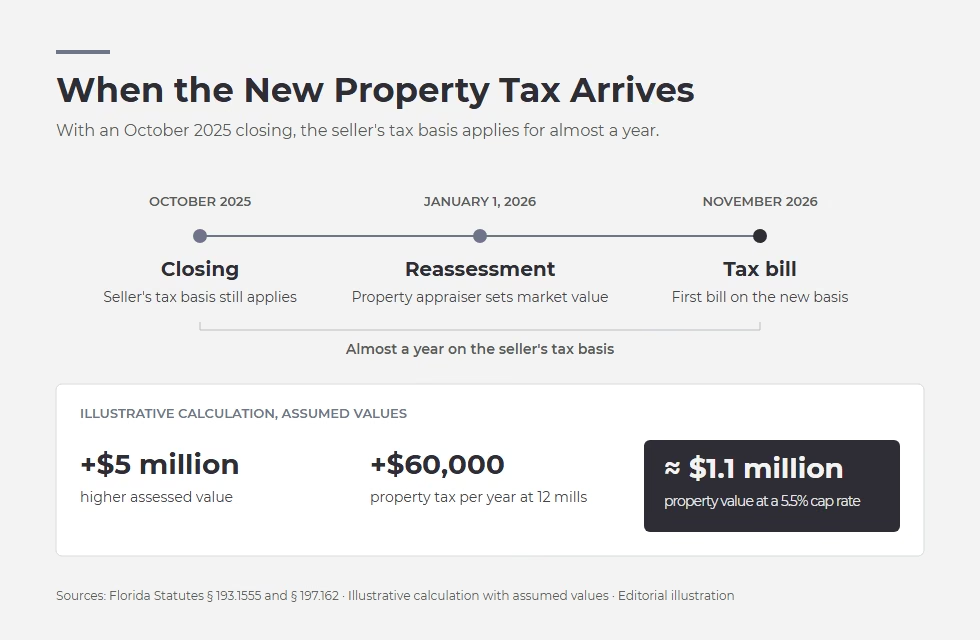
The first operating statements after an acquisition still reflect the seller’s property tax.
NOI falls by the same amount. At a 5.5% cap rate, that translates into approximately $1.1 million of property value. The figure appears nowhere in the offering memorandum because the seller never paid it.
A sound business plan therefore underwrites property taxes from the expected reassessed value, not from the seller’s last tax bill.
The Buyer Starts Over on Insurance
At closing, the buyer needs its own policy, and the lender generally requires coverage as a condition of funding. The seller’s last premium is no more than a reference point. In Florida, however, the deductible often matters more to cash-flow risk than the premium itself.
For commercial residential property policies, the hurricane deductible may be as high as 10% of insured value under Section 627.701 of the Florida Statutes. On a property with an insured value of $40 million and a 5% deductible, the owner bears the first $2 million of a storm loss.

The policy helps determine how much liquidity must remain available after a storm.
Insurers must also offer two alternatives: a deductible that applies once per calendar year and one that applies separately to each hurricane. That sounds like fine print until one recalls 2004, when four hurricanes struck Florida within six weeks. Under the per-storm option, this example could have exposed the owner to as much as $2 million more than once.
Business interruption coverage also has limits. As the Florida insurance regulator explains, it replaces lost income only for a defined period and only after a covered loss. If a unit remains vacant for three months beyond the covered period after water damage, the lost rent is not reimbursed.
For the business plan, the implication is straightforward: the deductible belongs in liquidity planning as a dollar amount, not merely as a percentage in the insurance file.
Cash in the Account Is Not Necessarily Available
At our property, the lender specified which work had to be completed and by when. Such schedules often also determine how much cash must be funded into an escrow account and when it may be released.
Freddie Mac’s guidance provides for dedicated repair escrows for priority repairs; funds are released only after completion has been documented. The specific conditions in each case are set out in the loan agreement.
On the property’s bank statement, this money looks like liquidity. It is not available for day-to-day operations. The same applies to security deposits and prepaid rent, which transfer to the new owner together with a tenant-by-tenant accounting under Section 83.49 of the Florida Statutes. Economically, those funds belong to the tenants.
A third restriction may arise under the loan agreement itself. If debt-service coverage falls below an agreed threshold, many loans with cash-management provisions redirect rental income to a lender-controlled account.
Whether the surplus remaining after operating expenses and debt service is retained there depends on the cash-trap provision. In such periods, the distinction between redirecting and retaining funds determines whether any distribution can be made even when NOI is positive.
One of our bridge financings illustrated how closely these agreements must be read. Our asset-management team had negotiated the exit fee out of the loan agreement. When the fee nevertheless appeared on a later invoice, pointing to the signed agreement was sufficient.
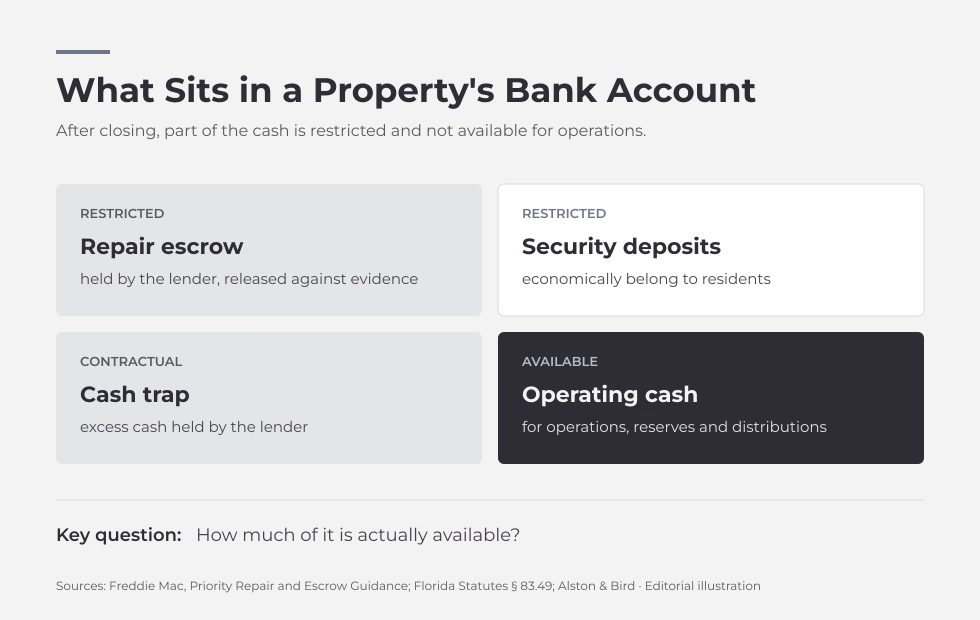
A property’s account balance says little about how much cash is actually available for operations and distributions.
Occupancy Rises Faster Than Cash Flow
A move from roughly 84% to roughly 96% in about four months is substantial. The urgent technical work was completed over the same period. The grounds are next because they are the first thing prospective tenants see when touring the property.

A renovated unit generates additional income only after a lease is signed on the expected terms.
The business plan assumes average occupancy of 93% for the first year. Whether the increase creates economic value depends on the terms of the new leases and the rent that is actually collected. We examined the difference between physical and economic occupancy in a separate article.
Another issue appears in no offering memorandum: when the leases expire. If 50 leases at a 250-unit property expire in the same month, vacancy can arrive all at once. We therefore offer residents different lease terms—for example, 10, 12 or 16 months—at different rents. The process is now supported by AI.
In Florida, this is more than an administrative detail. Approximately 608,000 multifamily units were completed in the United States in 2024, the highest number since 1986, with nearly half located in the South. New properties frequently use rent-free weeks to secure their first residents, placing existing properties in direct competition with them.
One free month on a twelve-month lease reduces effective rent by slightly more than 8%, even if the lease shows the full contractual rent. Lenders therefore distinguish between stabilized occupancy and stabilized operations, as Freddie Mac does in its guidance on valuing non-stabilized multifamily properties.
For investors, that is the more useful measure than a single percentage: the improvement becomes sustainable only when occupancy, collected rents and costs remain aligned over several months.
What First-Year Reporting Should Show
Investors who want to understand how a property is performing during its first year do not need an update on every replaced gutter. A regular budget-to-actual comparison is sufficient if it shows where the numbers changed with the acquisition:
- Property taxes: based on the expected new assessment, not the seller’s last tax bill;
- Insurance: the premium and deductible under the new policy, the deductible stated as a dollar amount, and the reserve held against it;
- Liquidity: separated into freely available cash, lender-restricted funds and tenant security deposits;
- Rents: contracted and actually collected, measured over several months and including concessions on new leases.
For a family office, there is an additional consideration that we discuss in greater detail in our article on family offices and real estate investments: the investment is expected to perform a defined role within a larger pool of wealth. If current distributions are expected, the report must distinguish income that has already been earned from assumptions about future years.
At our properties, investors can also access the property-management system directly. Read-only access allows them to see every transaction: whether and when a resident paid, and every invoice with its supporting document, from pool service to wall paint.
What the First Months Tell Us
At our property, the roofs are watertight, the lender’s deadlines for the first 90 days have been met and the units are well occupied. That is a solid interim result. Whether it develops into the planned cash flow will be determined by items that could not appear in the seller’s offering memorandum: the reassessed property tax bill, the buyer’s own insurance policy and the amount of liquidity that is genuinely unrestricted.
That is the operator’s work. Whitestone directs asset management, property management and on-site capital investment at its properties and invests its own capital alongside its investors in the same transactions. Our investors therefore receive the same operating figures we use to manage the property, including variances from the business plan.
An acquisition is not made successful on the day of closing. Its economics emerge in the months that follow—at the latest when the buyer receives its first property tax bill in November.