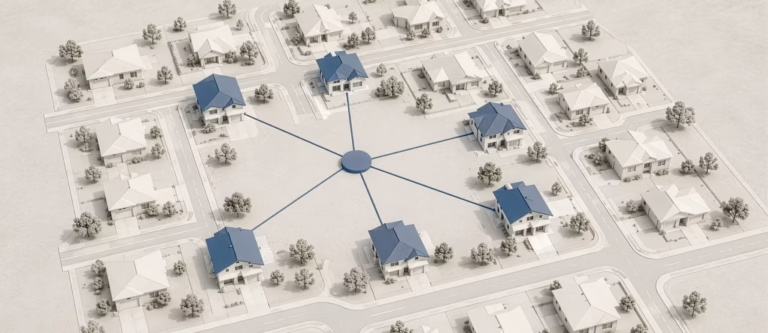

For investors and family offices, the real estate investment process begins well before due diligence. A suitable property must first reach the investor’s desk. In professional real estate markets, this is commonly referred to as “deal access.”
Deal access means access to transactions: to owners, brokers, banks and local market participants through whom an investor learns of an owner’s intention to sell and gains the opportunity to participate in a sale process. This access appears particularly valuable when a property has not yet been marketed broadly. “Off-market,” “confidential” or “offered only to selected investors” sounds like an advantage unavailable to other buyers.
That advantage can be real, and in certain circumstances it is. Access alone, however, says nothing about whether the property is being offered at a reasonable price or whether the projected cash flow is robust.
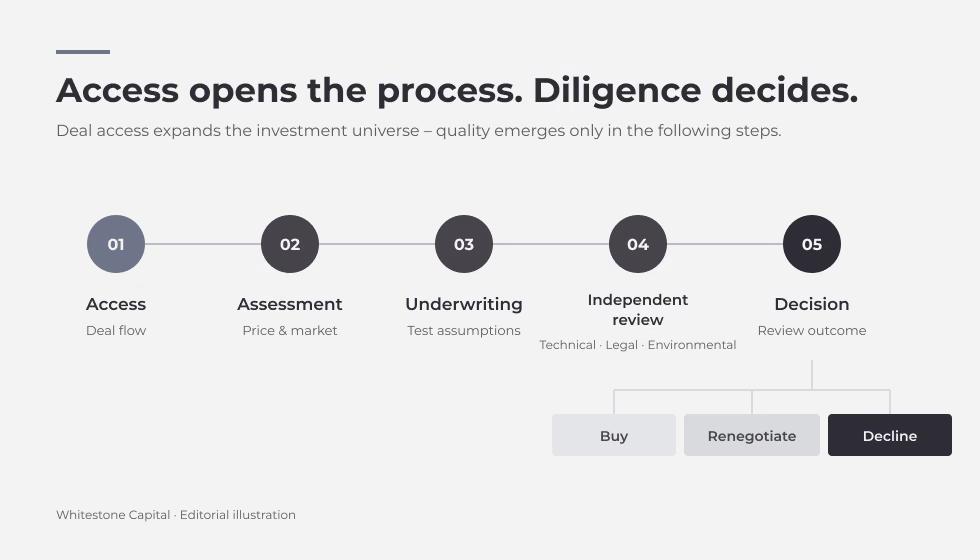
Deal access determines which transactions can be evaluated. Whether they qualify as sound investments is determined only afterward.
What Deal Access Actually Provides
Why Private Markets Work Differently from Public Markets
For listed securities, access offers little competitive advantage. In principle, any investor can buy a listed share at the prevailing market price, while prices and corporate reporting are available to all market participants at the same time.
Real estate works differently. An apartment community in Tampa has no continuously quoted market price, and not every prospective buyer learns of an owner’s intention to sell at the same time. Purchase prices are established through individual negotiations or bidding processes. The owner knows the property better than the prospective buyer, the property manager has different information from the broker, and a local investor may be aware of developments in the immediate area that cannot be inferred from an offering memorandum.
This applies in Germany as well as in the United States, although the level of available information differs. Ownership, financing and transaction data are more readily accessible in many U.S. markets. Even there, however, a substantial share of the information relevant to an investment decision remains property-specific and private.
The economic consequences of these information differences are well established empirically. Mark Garmaise and Tobias Moskowitz examined the U.S. commercial real estate market in a study published as an NBER Working Paper in 2002 and in the Review of Financial Studies in 2004. They identified three patterns in how market participants respond to information asymmetry:
- They prefer to invest close to their own location.
- They favor properties with long and verifiable income histories.
- They avoid transactions involving well-informed professional brokers.
The third finding is particularly relevant to the value of networks. A well-informed broker is not merely a source of information, but also a counterparty with an informational advantage and economic interests of its own. The study by Garmaise and Moskowitz demonstrates that professional market participants account for these information differences in their transaction behavior.
Where Access Can Create a Genuine Pricing Advantage
It would nevertheless be too simplistic to dismiss deal access as uniformly overrated. There are circumstances in which access creates a structural rather than merely incidental advantage.
This is the case when a seller places greater value on certainty of execution and speed than on achieving the highest possible price. Typical situations include:
- Failed sale processes in which a buyer withdrew after due diligence and the owner does not wish to conduct a second public process.
- Refinancing pressure or changes in the ownership group, where a maturing loan or fixed timetable limits the seller’s flexibility.
In such cases, the seller may be willing to trade a portion of the maximum achievable price for speed and certainty of execution. Any pricing advantage for the buyer arises not from exclusivity, but from solving a specific problem for the seller.
The value therefore lies in an improved basis for making a decision, not in exclusivity itself.
Off-Market Is a Distribution Method, Not a Measure of Quality
In real estate, “off-market” is often treated almost as a quality category in its own right, and that is problematic. The term initially means only that a property is not being marketed broadly. There may be valid reasons for this: an owner may wish to avoid unsettling employees or tenants, a family may prefer a discreet sale, or an institutional owner may initially approach only buyers with a proven ability to execute.
Discretion does not, however, imply a favorable purchase price. A property offered exclusively may be excellent; it may equally be overpriced or based on assumptions that fail under closer review. A seller who approaches only three prospective buyers has no reason to dispose of an asset below its value.
A smaller bidder pool primarily narrows the breadth of price discovery. Neither a discount nor a premium can be inferred from that fact alone.

Information Advantage Enables Better Assessment
What Local Information Actually Consists of
In private real estate investing, an information advantage rarely consists of a single secret fact. It is usually the result of many small pieces of information that together produce a more precise picture.
A local market participant knows which rents are actually being achieved in a submarket and which appear only in listings. They understand the quality of local property managers, the impact of a new development on rental conditions, and whether a seller needs to transact or is merely testing the market. In U.S. multifamily, relevant factors also include insurance terms, property taxes, construction costs, financing terms, new supply and concessions.
This information is legitimate and has nothing to do with inside information concerning listed companies. It is a matter of market knowledge, operating experience and the ability to interpret available information correctly.
Professional data providers have changed the starting point. Transaction databases, submarket analyses and pipeline data for planned development are now broadly available to professional market participants. This does not diminish the value of a local presence; it changes where that value lies. Databases provide averages and historical figures, but they cannot determine whether a reported submarket average applies to a particular block or whether a property manager is actually achieving the collections it reports.
The industry itself recognizes that better data have not eliminated the information problem. The CFA Institute continues to identify opacity and information asymmetry as central challenges in private markets and expressly recommends that institutional investors require sufficient information and be prepared to reject a transaction when conditions are problematic.
Greater access and more data should not lead to faster purchasing decisions. They should support better underwriting.
Why Familiarity Is No Substitute for Verification
A robust network generates deal flow and improves the information available. It also creates a risk: an opportunity introduced by someone known for many years automatically receives the benefit of the doubt.
An investor or family office knows the intermediary, the operator has worked with the seller before, and another investor from the same network may also be participating. None of these relationships changes the condition of the roof, the rent actually collected or the price.
A personal relationship may explain why a property enters the review process. It is not a reason to acquire it.
Due Diligence Starts with the Assumptions in the Business Plan
At the beginning of a sale process, the buyer receives information from which an initial business plan is prepared. A typical offering memorandum may state that 70% of the units have been renovated, that certain market rents appear achievable and that only limited capital expenditure is required. NOI, cash flow, financing and returns can then be modeled. At that stage, the result is an investment hypothesis—nothing more.
Due diligence tests that hypothesis against reality. “70% renovated” may mean that kitchens, bathrooms and flooring have been replaced in full. It may equally mean that only appliances or finishes were changed. A stated market rent may be supported by executed leases or by listings that have remained on the market for weeks. A roof may remain serviceable for several years and still create a material capital requirement today.
The business plan is not the outcome of due diligence; it is the subject of the review.
Professional underwriting must remain open in both directions: a review may also establish that a property is stronger than initially assumed.
A Rent Roll Is Not Cash Flow
What the Occupancy Rate Actually Represents
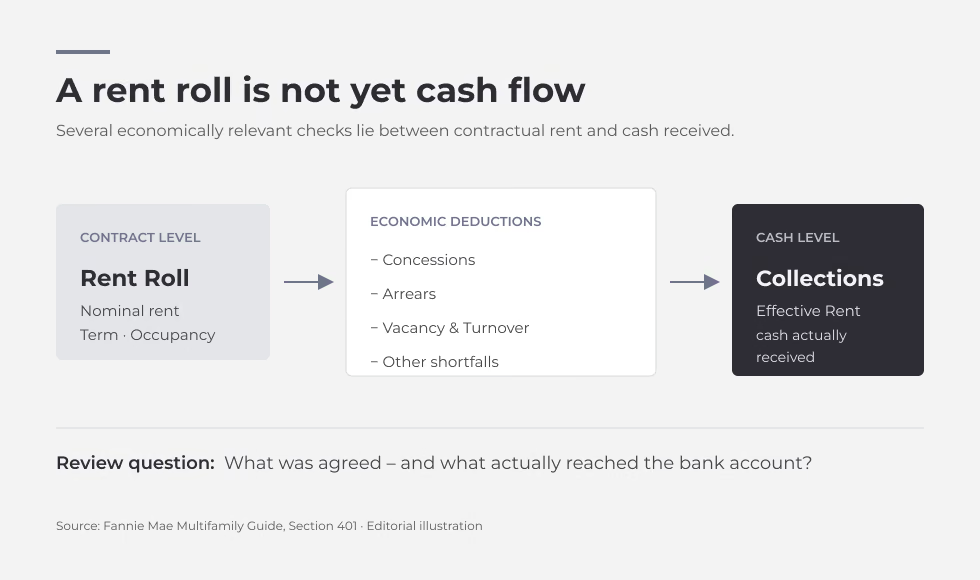
A 240-unit apartment community appears straightforward in a spreadsheet: unit number, floor plan, contract rent, lease start and lease end. Average rent and occupancy can be calculated within minutes. That is not enough to establish economic value.
Relevant questions include:
- whether the reported leases actually exist and have been signed,
- which concessions have been granted, including rent-free periods or discounts that reduce the effective rent,
- which residents are in arrears and how delinquent balances are developing,
- which leases have recently been renewed and on what terms,
- which sources of other income are actually collected rather than merely contracted.
Lenders and equity investors have different objectives: one assesses debt-service capacity, while the other tests the viability of the business plan. Institutional lending standards nevertheless provide a useful benchmark for the required depth of review. In its Multifamily Guide, Fannie Mae requires a lease audit that reconciles the rent roll with executed leases.
If material discrepancies are identified, the sample should be expanded. The review of actual rental income may include cash ledgers, receipt journals or bank statements, as well as an analysis of delinquent receivables.
A dollar of scheduled monthly rent is not necessarily a dollar collected. High occupancy has limited value if receivables are rising or residents can be retained only through substantial concessions. Conversely, a property with slightly lower nominal rents may be economically more attractive if collections are stable and turnover costs are low.
Loss to Lease and Trade-Outs
In value-add strategies, a metric that appears only indirectly in many offering materials can become an important driver of value: the difference between in-place rents and assumed market rents, commonly referred to as loss to lease.
A high loss to lease is not, by itself, a measure of quality. It may indicate that existing leases are below market. It may equally indicate that the assumed market rent is too high, that the resident profile is challenging or that significant turnover costs lie ahead. The relevant question is therefore not the size of the difference, but whether the assumed market rents can actually be achieved.
Trade-outs provide one of the most informative answers: the rent changes actually achieved on recent new leases and renewals. Both measures matter because new leasing and renewal performance can differ materially within the same portfolio. They should also be evaluated as effective rents after concessions, not as nominal contract rents. Two months of free rent on a twelve-month lease reduce the effective rent by approximately 17%, regardless of the amount stated in the lease.
Reporting loss to lease without demonstrating the effective trade-outs describes an assumption, not value creation.
Physical Condition and Insurability
What a Technical Assessment Must Cover
Terms such as “well maintained” or “recently upgraded” are descriptions. They become useful only when the work completed and the work still required are clearly defined: roofs, HVAC systems, plumbing, electrical systems, windows, façades, drainage and site improvements.
A technical detail can materially alter the investment case. A roof budget of $500,000 and an actual requirement of $1.2 million represent approximately $2,900 of additional capital expenditure per unit at a 240-unit property. This is not a minor adjustment in a spreadsheet. The difference must be absorbed through a lower purchase price, a different financing structure, additional equity or a revised return requirement.
Institutional lenders treat this area accordingly. Fannie Mae generally requires a Property Condition Assessment for multifamily financing to identify, among other matters, conditions that may impair the property’s safety, marketability or value.
The equity investor must also understand which capital requirements will arise during the intended holding period and how they will affect cash flow.

Insurance as a Distinct Cost Category
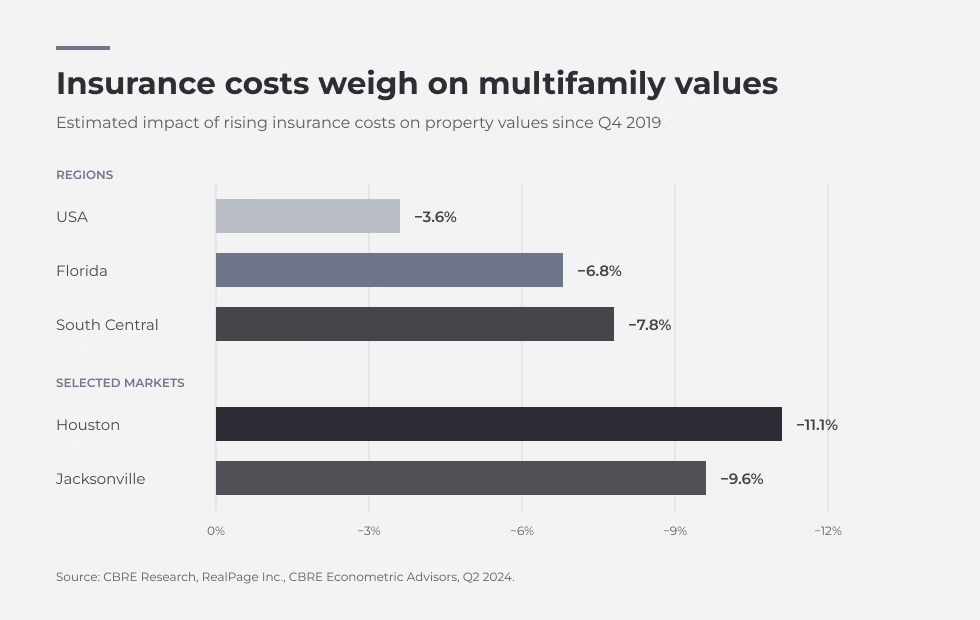
In Florida and across much of the Sun Belt, property insurance has moved from an incidental operating expense to a factor with a direct bearing on valuation. CBRE has quantified the effect. Its analysis estimates that higher insurance costs have reduced multifamily values since the fourth quarter of 2019 by approximately 3.6% nationwide, 6.8% in Florida and 7.8% in the South Central region. In individual markets, CBRE estimates the effect at approximately 11% in Houston and just under 10% in Jacksonville.
Within the portfolio of multifamily properties analyzed by Trepp—properties that serve as collateral for securitized multifamily mortgages—Florida has recently shown a countertrend. Median property insurance costs declined by 6.2% year over year in 2025, while increasing by 3.4% across the other U.S. states. For due diligence, this does not constitute an all-clear. Both the peaks recorded in 2022 and 2023 and the recent moderation could be extrapolated incorrectly in an expense forecast.
A rigorous review therefore treats insurance not merely as a line item in the operating statement, but as a separate area of investigation:
- How has the premium developed over the past three to five years, and what deductibles apply, particularly for named-storm and water damage?
- What premium would a new owner pay at closing, rather than what the seller pays today?
- Can the property be insured in the market on acceptable terms at all?
The final question is the most important. A property that can be insured only at prohibitively high premiums or with very high deductibles presents both a financing risk and an exit risk, irrespective of rental performance.
Local Expertise Shows in the Analysis, Not in the Address Book
A capable local operator should have access to brokers, banks, owners and service providers. The decisive value of a local presence, however, emerges when the available information must be assessed.
An asking rent of $1,800 may be conservative in one submarket and ambitious only a few miles away. A $15,000 renovation per unit may be justified if the incremental rent supports the expenditure. In another submarket, the same investment may purchase finishes for which the target resident is unwilling to pay.
The same principle applies to location. Strong population growth across a Metropolitan Statistical Area says little about whether the specific submarket under consideration is simultaneously coming under pressure from substantial new supply. Low market-wide vacancy does not protect an individual property from an unsuitable unit mix or weak operating performance.
Why the Operator Has Better Reference Data
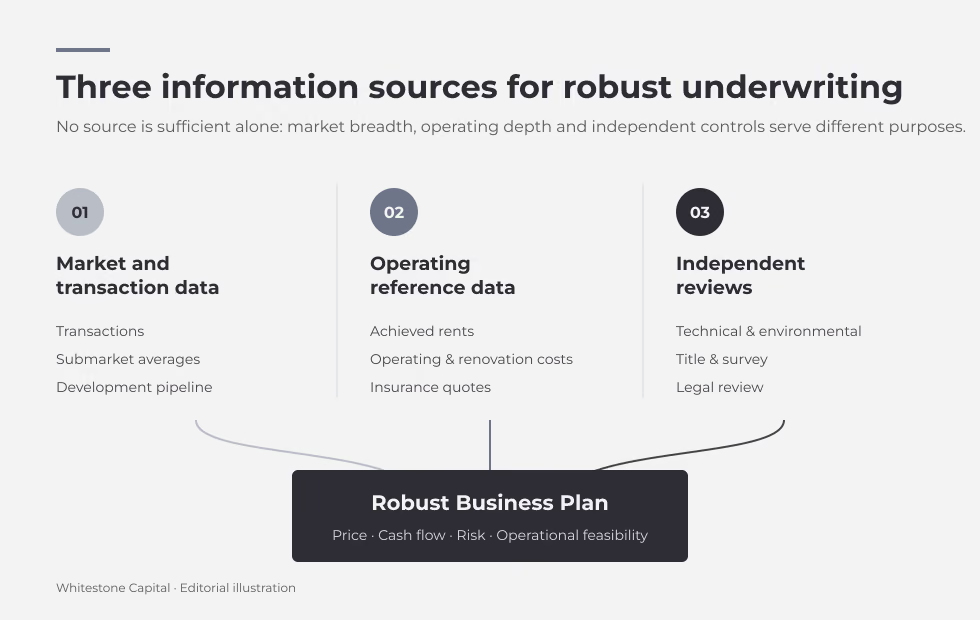
This raises a question that is often overlooked in discussions of due diligence: why should the local operator conduct the review? A family office could retain an independent service provider instead. The difference lies in the reference base against which the property is assessed.
An external reviewer works with market data. The property is compared with averages, published transactions and industry benchmarks. This is methodologically sound and produces reasonable conclusions.
An operator that manages its own properties in the same submarket works with its own figures:
- It knows the actual operating costs of comparable properties because it incurs those costs itself.
- It knows which rent increases can be achieved because it has negotiated them in the same market.
- It knows the cost of renovations because it completed similar work at several properties during the previous year.
- It knows property managers through direct working relationships rather than reference lists.
- It knows the insurance terms available in practice because it obtains quotes for its own portfolio.
This is the difference between a plausible assessment and a well-supported assessment of the property’s economics.
This advantage has a clear limit, and it should be stated openly. It applies to commercial underwriting: rents, operating expenses, renovation costs and the submarket. It does not extend to reviews whose value derives precisely from their independence.
Proprietary operating data do not replace independent technical, legal and environmental reviews. They complement them.
Property Condition Assessments, Environmental Site Assessments, title and survey work, and legal review should be conducted by independent third parties whose compensation does not depend on the transaction closing. An operator may reduce costs by bringing these functions in-house, but doing so removes an independent control.
Alignment of Interests: Who Has Capital at Risk?
This structure creates a conflict of interest that a family office should address directly. If the same partner sources, underwrites and subsequently manages the transaction, that partner has an economic interest in the acquisition proceeding. A compensation structure dominated by transaction-based fees rewards closings rather than outcomes. This is not an accusation directed at an industry; it is a structural characteristic that must be understood and addressed.
The operator’s own equity in the same investment is one of the strongest indicators of alignment. An operator that commits a meaningful portion of its own capital on equivalent or subordinated terms bears part of the same economic consequences as the other investors. Co-investment, however, is no substitute for reviewing the fee structure, decision rights and waterfall.
Relevant questions include:
- How much equity is the operator investing, both in absolute terms and relative to the capital raised from investors?
- Does that capital rank pari passu with investor capital, or is it subordinated?
- Which fees are payable irrespective of investment performance, including acquisition, asset management or refinancing fees?
- At what return threshold does performance participation begin, and is it paid only after investors have received a full return of capital?
- Who decides whether additional capital is required, and what happens to the interests of existing investors?
These questions belong at the beginning of a negotiation, not in its final stages.
A Good Deal May Look Worse After Due Diligence
In many investment presentations, the analysis moves in only one direction. An attractive property is identified and arguments are then assembled in support of the acquisition. A professional process must allow for a different conclusion.
A typical situation may unfold as follows: a property is offered discreetly, the figures appear sound and the initial proposition is attractive. The review then establishes that a material portion of reported occupancy is supported by leases with several months of free rent, that achieved trade-outs are substantially below the assumed market rents and that the insurance premium will be reset when ownership changes.
None of these findings automatically makes the property a poor investment. They do, however, change the price at which it makes economic sense.
Due diligence can therefore produce several legitimate outcomes:
- The original business plan is broadly confirmed.
- The buyer and seller revise the commercial terms.
- The financing structure is changed.
- The buyer concludes that the expected return no longer adequately compensates for the risk.
The final outcome is not a failed due diligence process. A review has served its purpose even when no closing takes place. The alternative is to discover only after closing why a supposedly exclusive opportunity was so readily accessible.

What Family Offices Should Expect from a Local Operator
Professional division of responsibilities does not require a family office to inspect every property itself. An investor in Berlin, Hamburg or Zurich does not need a better understanding of rental trends in individual Tampa neighborhoods than the local operator. Nor does the investor need to walk 200 units or obtain bids for roofing work directly.
The investor should, however, be able to understand the information on which a decision was based. A small number of precise questions is sufficient:
- Where did the transaction originate, and was the property marketed broadly or offered directly?
- What specific advantage did that access create?
- Which assumptions came from the seller, and which were tested independently?
- What changes to the business plan resulted from due diligence?
- Which reference data from the operator’s own portfolio were used to test the assumptions?
- Which risks are already reflected in the purchase price, and which remain after closing?
- What is expected to generate the planned return, and which components depend on market conditions?
- How much of its own capital is the operator investing, and on what terms?
This transparency is more important than a promise to produce a continuous stream of exclusive opportunities.
A family office delegates operating responsibilities to a local investment partner. It should not delegate its ability to understand and oversee the investment rationale.
Access Is a Prerequisite, Not an Outcome
A strong network is an integral part of private real estate markets. It creates relationships, information and access to transactions, and in a local business such as U.S. multifamily that access can have substantial value. Its importance is overstated, however, when exclusivity is treated as evidence of quality.
The actual advantage results from the interaction of three elements. Access makes it possible to evaluate a property in the first place. Local experience and proprietary reference data help place the information in context. Due diligence determines which assumptions withstand contact with operating reality.
Whitestone does not determine a family’s capital allocation. Our role begins once a family has decided that U.S. multifamily should form part of its real estate allocation. From that point, we are responsible for ensuring that a property is not merely accessible, but economically viable, and we invest our own capital in the same transactions.
An investment is not sound because few people know about it. It is sound when price, cash flow, risk and operating reality are aligned.