
A shorter version of this article was published on July 17, 2026, in Der Immobilienbrief, Issue 628.
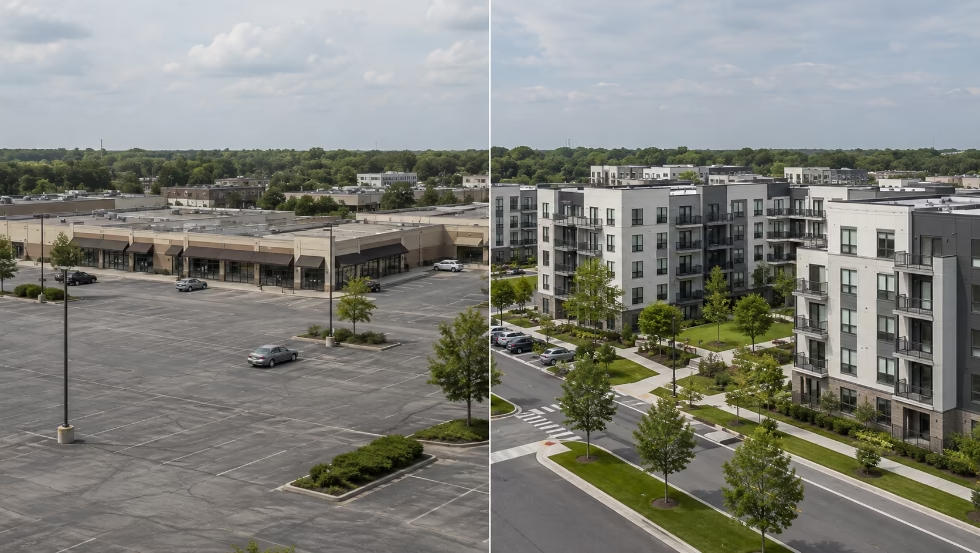
At Innsbrucker Platz in Berlin, the German housing debate can be observed within just a few hundred meters. On the site of the former Wilmersdorf freight yard, the Friedenauer Höhe development has created a new neighborhood with a total of 1,302 homes: 933 market-rate rental apartments, 131 owner-occupied units, and 238 subsidized apartments owned by the state-owned housing company HOWOGE.
The difference between these two rental markets is substantial. Average net base rents in the market-rate portion of the development are reported at around €25 per square meter. By contrast, a recent re-letting by HOWOGE at Lauterplatz was offered at €8.40 per square meter and required a housing eligibility certificate. This single figure does not necessarily represent all 238 subsidized units, but it illustrates the scale of the difference.
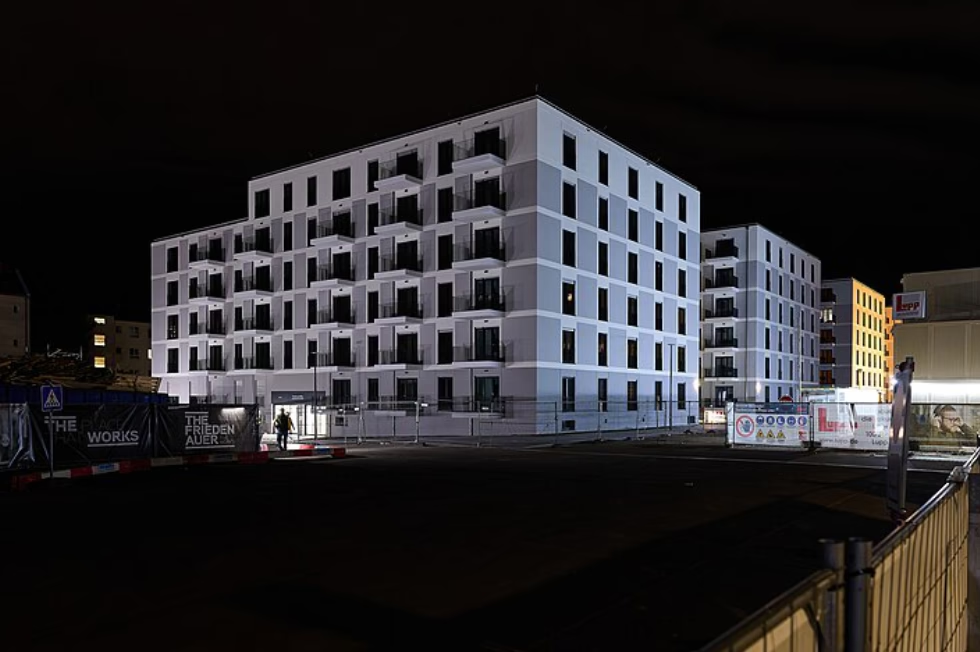
Anyone who concludes from this that market-rate new construction does not directly solve the acute housing needs of a low-income household is correct. An apartment renting for €25 per square meter is not social housing. Affordable homes at Friedenauer Höhe were created primarily where public subsidies, rent restrictions, and a state-owned housing company came together.
The argument becomes flawed only in the next step: when the high price of a newly built apartment is taken to mean that it provides no benefit to the wider housing market.
The people who live at Friedenauer Höhe today would not have disappeared without the development. Households that moved there from elsewhere in Berlin vacated their previous homes. Households newly arriving in Berlin would otherwise have searched within the existing housing stock. New construction therefore absorbs demand, even when its first residents pay above-average rents.
That is precisely the distinction between the price of an individual apartment and its effect on the wider market. New construction does not have to be inexpensive itself to reduce competitive pressure on older homes. It creates moving chains, expands choice, and removes households from the competition for existing housing.
The development nevertheless shows why the blanket claim that “new construction benefits only the wealthy” is too simplistic.
Germany’s problem is not that homes were built at Innsbrucker Platz. It is the combination of high construction costs, lengthy processes, and a level of supply that remains insufficient to exert meaningful pressure on the Berlin market—even with a development of this scale.
Germany Is Reforming Planning Law—but Not the Investment Case
In 2025, 206,586 homes were completed across Germany. That was 18% fewer than in the previous year and around 30% fewer than in 2022.
Housing permits recently showed a modest countermovement. Their number rose by 10.6% in 2025 to approximately 238,000. Yet this is still far from a genuine recovery: compared with 2022, the total remains roughly one-third lower.
The construction backlog is particularly revealing. At the end of 2025, around 761,000 homes had been permitted but not yet completed. At the same time, 35,700 permits expired within a single year—the highest figure since 2002. Germany therefore does not merely have too few permitted projects.
It has hundreds of thousands of permitted homes that are nevertheless not being built, or will no longer be built at all.
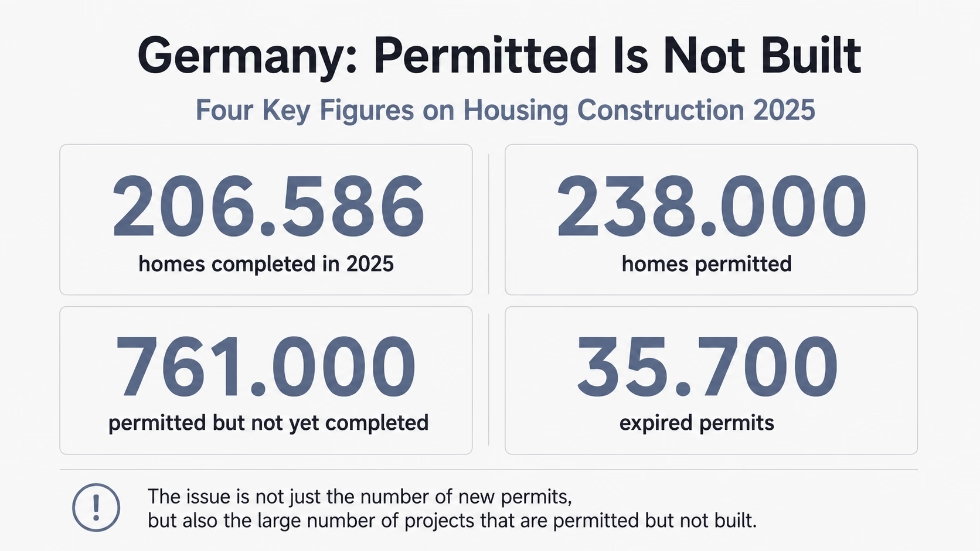
Source: German Federal Statistical Office, housing completions, building permits, and construction backlog, 2025.
The federal government has responded with another reform of the German Building Code. The bill submitted to the Bundestag in June 2026 does contain several sensible changes: planning procedures are to become fully digital, duplicate consultation processes are to be reduced, environmental reviews are to focus more closely on material conflicts, and housing construction is to receive greater weight in the balancing of interests in tight markets. The previously mandatory early consultation stage is to become discretionary for municipalities, while formal public consultation will remain in place.
This may accelerate procedures. It does not, however, solve the entire investment equation.
A digitally transmitted development plan does not reduce borrowing costs or land prices. A shorter consultation process does not offset construction costs that can be financed only through very high rents for newly built units. A statutory declaration of public interest does not create equity, nor does it compel an owner to begin a project that is no longer economically viable.
Friedenauer Höhe at Innsbrucker Platz captures this tension within a single neighborhood. After a lengthy planning and development process, more than 1,300 homes have been completed there—a tangible gain for Berlin.
At the same time, rents in the market-rate portion remain beyond the reach of many households. The problem is not that these homes were built. The problem is a system in which even large developments take years to deliver and market-rate new construction must ultimately command around €25 per square meter.
Germany’s housing construction crisis cannot therefore be reduced to a single statutory provision. Planning law, municipal procedures, construction costs, financing, land prices, and achievable rents are all interdependent. Reforming planning law is sensible. But it remains a reform of process—not of the economic conditions under which housing is built.
What Policymakers Could Have Done
A professional developer does not begin by asking which new subsidy program sounds politically attractive. The calculation starts with the rent households at a given location can realistically afford. The developer then determines the maximum land, construction, financing, and approval costs that still allow the project to work at that rent.
Policymakers should have applied the same calculation.
Create More Development Rights in the Right Locations
Where infrastructure, public transit, schools, and services already exist, higher density must be possible: more floors, vertical extensions, reduced setback requirements, easier conversions, and less rigid parking mandates. At a transportation hub such as Innsbrucker Platz, artificially constraining housing through low density is difficult to justify economically or environmentally. More permitted floor area on the same site spreads land and infrastructure costs across a greater number of homes.
Make Existing Development Land Truly Available
Former rail sites, underused commercial properties, and publicly owned land benefit the housing market only when they are made ready for development. Municipalities could have prepared such sites earlier, organized planning work in parallel, and awarded land subject to clear construction obligations. Friedenauer Höhe illustrates the problem: the site existed, and so did the demand. Yet nearly two decades elapsed between the first planning steps and full completion.
Make Permitting Binding and Accountable
A project needs a single responsible contact, an early completeness review, a shared digital file, and specialist authorities working in parallel. Reviews of transportation, environmental impact, fire safety, and infrastructure should not begin sequentially when they can proceed simultaneously. This also requires reliable deadlines and a duty to reach a decision—not merely nonbinding political targets. The Housing Construction Accelerator, in force since late 2025, demonstrates that further acceleration is legally possible: under certain conditions, municipalities may approve additional housing without initiating a new development-plan procedure. The decisive question, however, is whether they actually use these instruments.
Assess Standards by the Housing Value They Create
Technical requirements are appropriate where they ensure safety, durability, or economically reasonable energy use. Yet not every conceivable additional feature justifies the cost it permanently adds to rent. More consistent building codes, modular construction, reusable designs, and a robust building type with simpler standards could have reduced costs more effectively than another narrowly designed subsidy program. Affordable housing is not created by requiring every new home to meet the highest technically achievable standard.
Target Subsidies to Households the Market Cannot Reach
The HOWOGE apartments at Friedenauer Höhe demonstrate why subsidized housing remains necessary. Very-low-income households do not benefit quickly enough from general moving chains. They need social housing, housing allowances, and long-term occupancy restrictions. Yet subsidy conditions must be established at the outset of a project and remain reliable throughout the planning and construction period. Funding freezes, changing standards, and programs redesigned every year increase risk—and ultimately the rent the project must charge.
Give Investors Regulatory Certainty
Housing construction ties up capital for years, often for decades. Land acquisition, financing, and construction contracts are based on assumptions about taxes, regulation, permitted use, and future leasing. If these conditions change fundamentally during development, more than the return is affected. The entire project may become uneconomic. Reliable rules are therefore not a concession to investors. They are a prerequisite for private capital to finance housing over the long term.
Germany should have approached housing construction as a professional developer would: work backward from the affordable rent, create more usable development rights, organize permitting around binding decisions, review cost-driving standards, and direct subsidies to areas where the market alone is insufficient.
Instead, policymakers spent years regulating the existing shortage. Rent caps, neighborhood preservation rules, and additional procedural requirements can protect individual households. They do not create additional homes.
The central policy failure was therefore not a lack of discussion about affordability. It was the failure to address the conditions of affordable production for too long.
What Austin Did Differently
Austin was not always a model of a balanced housing market. Between 2010 and 2019, rents rose by almost 93%—more than in any other major U.S. city. Technology companies, new jobs, and rapid population growth met a housing supply that failed to keep pace with demand.
The city did not respond with a single headline-grabbing reform. Over a period of years, it changed the conditions under which housing could be built.
- Selected locations allowed taller buildings and more homes per site.
- Rules governing additional dwelling units on existing lots were relaxed.
- Minimum parking requirements were first removed in selected areas and, by the end of 2023, across nearly the entire city.
- Many lots previously reserved primarily for single-family homes can now accommodate up to three units.
- The minimum size of new residential lots was reduced from 5,750 to 1,800 square feet.
- Smaller multifamily developments now follow simplified procedures.
Austin combined this opening of the market with targeted housing policy.
Density bonuses permit additional floors when a project includes income-restricted units. Austin did not rely on the market alone. In 2018 and 2022, voters authorized the city to raise a total of $600 million through municipal bonds and invest it specifically in affordable housing.
The decisive difference from Germany is not a simplistic opposition between market and government. Austin used both instruments where they were effective: more development rights and less artificial scarcity for the broader market, and public support for households the market cannot reach on its own.
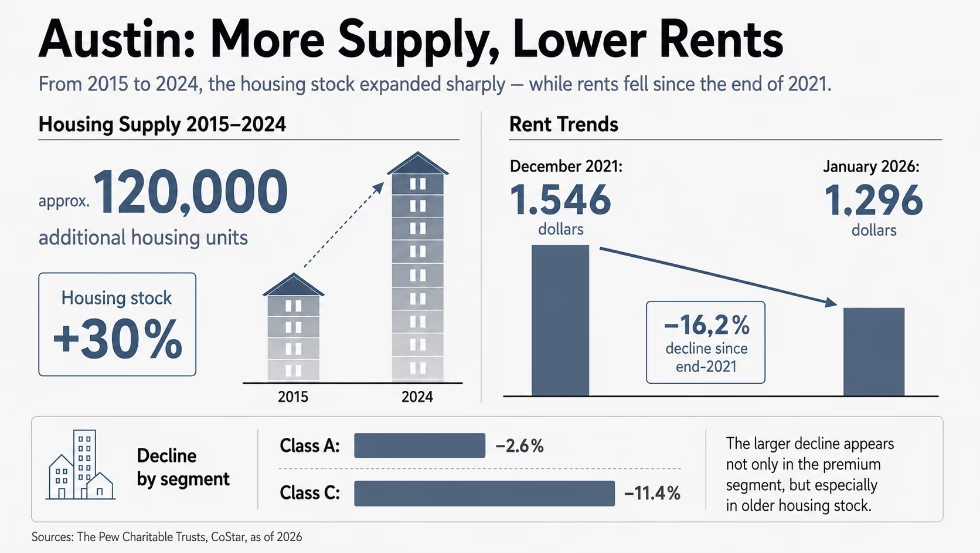
The result was large enough to influence the entire housing market. Between 2015 and 2024, Austin added approximately 120,000 housing units. The housing stock grew by 30%—more than three times the U.S. average. In purely numerical terms, that is roughly equivalent to 90 developments the size of Friedenauer Höhe.
Despite continued population growth, the rental market began to turn. The median rent, which had stood at $1,546 in December 2021, fell to $1,296 by January 2026. Austin moved from 15% above the U.S. median to 4% below it.
New construction did not become socially effective because new premium apartments suddenly became inexpensive. Its impact came through competition. New buildings absorbed households that would otherwise have searched within the existing stock. Vacancies rose, landlords had to offer concessions, and downward pricing pressure ultimately reached older apartments as well.
To be clear: this development was not uniformly positive for owners. Projects underwritten on the assumption of permanently rising rents came under pressure. Some investors had mistaken a market peak for a lasting trend. For owners who underwrote too aggressively, the correction is painful. That does not negate the housing-policy effect of additional supply.
A housing market does not become more affordable for renters without suppliers losing some of their pricing power.
Austin has not solved its housing challenge once and for all. Housing remains scarce for very-low-income households, and a decline in new construction could cause rents to rise again.
The city has nevertheless demonstrated what happens when housing construction is not merely demanded politically, but actually enabled at a scale large enough to influence the market.
After a process lasting nearly two decades, Berlin delivered 1,302 homes at Innsbrucker Platz. Austin created 120,000 housing units within ten years.
Germany debates how to distribute scarcity more fairly. Austin expanded supply—and began to reduce the shortage itself.
The Capital Allocation Question
Austin is not an isolated exception within an otherwise unchanged U.S. system. Florida now applies the same underlying logic at the state level: housing construction should not depend entirely on whether a municipality is willing to change its existing land-use policy.
The Live Local Act, enacted in 2023 and expanded several times since, intervenes at precisely this point. Qualifying multifamily and mixed-use projects must be permitted on many commercially, industrially, or mixed-use zoned sites if at least 40% of the units remain income-restricted for a minimum of 30 years.
For such projects, a municipality may not first require rezoning, a comprehensive-plan amendment, a special exception, or an individual political approval, provided the use, density, and building height are prescribed by statute.
Since July 2026, these provisions have also applied to certain properties owned by municipalities, counties, school districts, and religious institutions.
This does not mean that Florida eliminates all regulation. A project must still comply with building codes, fire safety, infrastructure, environmental law, flood protection, and stormwater requirements. The decisive difference lies elsewhere: for qualifying projects, state law has already answered the fundamental question of whether multifamily housing may be built on an appropriate site.
Florida does not thereby remove all authority from local decision-makers. But the state limits their ability to block housing in principle through lengthy rezoning procedures, political hearings, or additional discretionary decisions.
This is not deregulation at any cost. The additional development rights are tied to a substantial social contribution: at least 40% of the units must remain available for decades to households within defined income limits. Florida therefore combines two objectives that Germany often treats as opposing goals: greater private development rights and permanently income-restricted housing.
The state also takes a different approach to rent formation. Florida of course has binding rules governing leases, maintenance, security deposits, and eviction procedures. Local rent controls are generally preempted. Rent levels are determined primarily by contract, demand, and available supply.
For investors from Germany, Austria, and Switzerland, this is not a matter of political preference. It is a capital allocation decision.
Capital flows to markets where demand, development rights, costs, and expected income can be modeled with an acceptable degree of uncertainty. In Germany, even after land has been acquired and years have been spent on planning, many projects still face uncertainty over the density that will ultimately be approved, the additional requirements that may emerge, and whether the investment case will remain viable through completion.
Florida is not a paradise. Insurance costs, hurricane and flood exposure, property taxes, financing costs, and local development pipelines belong in every serious underwriting process. Population growth should not simply be extrapolated in a straight line.
Even so, the structural difference remains substantial. Florida’s population has grown by almost 9% since 2020. The state is responding to this demand not only with subsidy programs, but also with development rights secured by state law and limits on local obstruction.
Germany is trying to make housing affordable after making its creation more expensive and slower for years. Florida intervenes earlier: at the question of whether sufficient supply may be built at all.