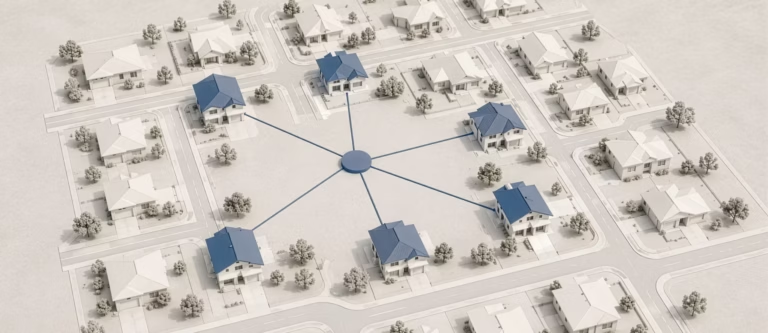


A business sale solves one problem and creates another at the same time.
For years or decades, a large share of the family’s wealth was tied to something it knew intimately: its own business. It knew the customers, employees, margins, competitors, financing and risks. Decisions were not made from a distance, but from daily experience.
With the sale, that logic changes very quickly. A concentrated enterprise value turns into liquidity. The wealth suddenly becomes more mobile. The expertise required to invest it across different asset classes, markets and managers, however, does not arrive at the same time as the sale proceeds.
Capital can become liquid in a single day. Investment expertise cannot. This is one of the most underestimated changes after an exit.
Concentration Was Often Not a Mistake in Building Wealth
Diversification is one of the fundamental principles of professional investing, as we discuss in more detail in our article on systemic risk and diversification. Yet the creation of substantial entrepreneurial wealth often works in exactly the opposite way.
Many entrepreneurs did not become wealthy by spreading their capital across twenty asset classes as early as possible. They concentrated time, capital and risk on one company, one industry or one product they understood better than others. Wealth is often created this way: through concentration, not despite it. The task changes only when entrepreneurial wealth becomes investable capital.
The exceptional role of private businesses in large fortunes is well documented on both sides of the Atlantic. In the United States, Federal Reserve research based on the Survey of Consumer Finances shows that interests in privately held businesses account for a substantial share of the wealth of affluent households.
In Germany, the Bundesbank reaches the same conclusion in its Distributional Wealth Accounts: The wealthiest one percent of German households alone hold around €2.25 trillion in business wealth, predominantly in the form of unlisted equity interests. The same observation therefore applies on both sides of the Atlantic: large fortunes are rarely broadly diversified portfolios at the outset. They are businesses.

That is not a problem in itself. An entrepreneur has an information advantage in relation to their own business that an outside investor can hardly replicate.
They do not know everything. But they know far more about their own business than they do about the next private equity fund, an apartment project in Florida or an investment in Singapore.
Concentration and competence can therefore be rational partners for many years.
After a sale, they part company.
An Exit Changes More Than the Asset Base — It Changes the Task
Before an exit, the central question is often: How do we continue to develop our company? Afterward, it becomes: What role should this capital play in the future? Both questions sound like capital allocation. Only one of them can be answered with the experience that made the sale possible in the first place.
Suddenly, decisions have to be made about liquidity, capital preservation, growth, investment horizons, currencies, jurisdictions, real estate, equities, private equity, bonds and other investments.
Most importantly, the nature of control changes. In one’s own business, control means being able to act directly. After an exit, control often means selecting the right structures, managers and partners — and being able to assess their work.
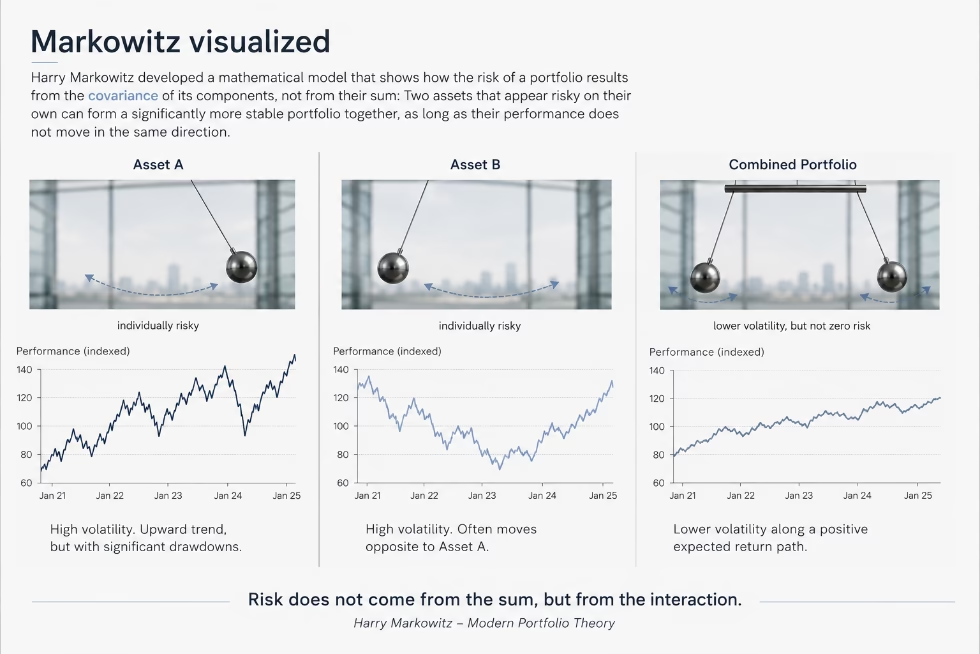
Harry Markowitz received the Nobel Prize in Economic Sciences in 1990 for his work on portfolio theory, together with Merton Miller and William Sharpe. His contribution was not a simple instruction to hold as many positions as possible.
He provided a mathematical model showing that portfolio risk derives from the covariance of its components, not from the sum of their individual risks: two assets that appear risky on their own can produce a significantly more stable portfolio when held together, provided their values do not move in the same direction.
Further details can be found in the Nobel Foundation’s press release announcing the award. For an entrepreneur whose wealth had previously been concentrated in a single, highly correlated bundle of operating business, real estate and personal liquidity, this is precisely the critical shift. What matters is not the number of positions, but how independent their risks are from one another.
For an entrepreneur after an exit, this leads to a consequence that is rarely stated openly but lies at the heart of any post-exit wealth strategy: the very concentration that was successful in building wealth becomes one of the central questions of wealth preservation after the sale. Following a liquidity event, the concentrated entrepreneur becomes a capital allocator who must think not only about how wealth is created, but also about how it is preserved, distributed and carried into the next generation.
Liquidity Creates Freedom and Decision Pressure at the Same Time
A major exit creates room to act, but it does not automatically create clarity.
Anyone who suddenly has to manage substantial liquid wealth after decades of entrepreneurial work quickly discovers just how extensive the range of supposedly sensible solutions has become. Banks have products. Private equity firms have funds. Wealth managers have strategies. Real estate companies have projects. Advisers have structures.
A look at the portfolios of professional family offices themselves shows just how complex this landscape has become. According to the UBS Global Family Office Report 2026, the average portfolio allocates 42 percent to so-called alternative investments — assets outside traditional equities and bonds, such as private equity, hedge funds, infrastructure and real estate — and 29 percent to private markets, the particularly illiquid core of that universe: unlisted company interests, venture capital and private credit.
Even organizations whose sole purpose is to manage a single large fortune have therefore spread their capital across a network of asset classes that can no longer be assessed from a single perspective. For a family that is only just moving out of one concentrated asset, this is both a warning and a guide.
The problem is rarely a lack of opportunities, but the sequence in which decisions are made.
A family does not first need to know which fund it wants to subscribe to or which building it wants to buy. It first needs to define the characteristics the overall wealth should have in the future:
- How much liquidity should remain available at all times?
- What level of value fluctuation is acceptable?
- What investment horizon is appropriate for the family?
- Which risks should be taken deliberately, and which dependencies should be reduced?
- Where does the family have its own expertise — and where does it not?
- Which decisions must remain within the family, and which can be delegated to specialists?

Only then does a collection of interesting opportunities become an investment strategy.
From Entrepreneur to Capital Allocator
This transition is often underestimated because both roles involve capital and significant responsibility. In reality, they require different skills.
A good entrepreneur does not have to be a good portfolio manager. Conversely, it would be absurd to expect an outstanding portfolio manager to be automatically capable of running an industrial company, a chain of hair salons or a clinic.
Before the sale, the competitive advantage may have been an exceptional understanding of a particular production method, market or industry.
After the sale, part of the new task is to assess people who are expected to understand other things exceptionally well.
This is no less significant a responsibility than running a business. It is a different discipline: being able to judge expertise without possessing that expertise oneself. The priorities of professional family offices show how central this capability has become. Eighty-nine percent of the family offices surveyed by UBS regard access to experienced investment professionals as the single most important success factor, while 79 percent deliberately outsource at least part of their investment management.
What is particularly interesting is how rarely the separation between entrepreneur and investor is complete in practice. According to the UBS Global Family Office Report 2026, 77 percent of the family-office families surveyed still owned an active operating business. Most families that have long since diversified their capital professionally therefore continue to carry precisely the concentrated entrepreneurial risk we are discussing.
The two roles rarely replace one another neatly. They usually continue in parallel, which means that distinguishing between entrepreneurial expertise and allocation expertise is not a one-time transition, but an ongoing task that can last for years.
The idea that entrepreneurs sit on one side and pure financial investors on the other is therefore too simplistic. Many families operate in both worlds at the same time. That is precisely why the distinction matters. Entrepreneurial expertise can be valuable. But it cannot automatically be transferred to every new asset class.
Diversification Takes More Than Holding Many Different Positions
After an exit, the temptation is to unwind the previous concentration risk as quickly as possible. Some equities, real estate, private equity, bonds, infrastructure, perhaps gold, several banks, several countries.
On paper, a diversified portfolio can be created very quickly. In practice, it can just as quickly become a structure that no one fully understands anymore.
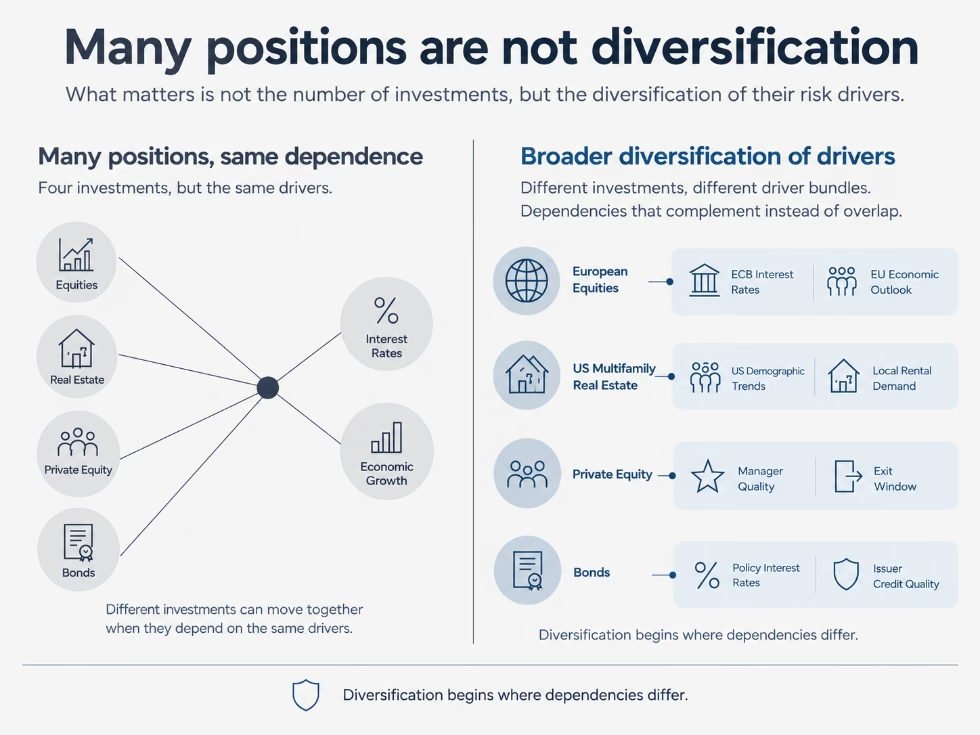
Diversification has several dimensions: asset class, sector, geography, currency, counterparty, manager, financing, liquidity and regulatory environment. Ten investments can look very different and still depend on the same economic conditions.
The latest UBS report shows how seriously professional family offices now take this issue: 60 percent plan to change their strategic asset allocation over the next twelve months. Among European family offices, the figure is as high as 67 percent — the highest level UBS has ever recorded.
That is remarkable because strategic allocation has traditionally been the most stable part of a family-office portfolio and is rarely adjusted in response to short-term developments. If this part of the portfolio is being reconsidered on such a scale, it is a signal that even highly professional organizations dedicated exclusively to capital allocation no longer consider some of their previous assumptions sufficiently robust. For an entrepreneurial family going through this exercise for the first time, that is not a reason for concern but a confirmation: restraint and diligence are not weaknesses in the current environment; they are professional standards.
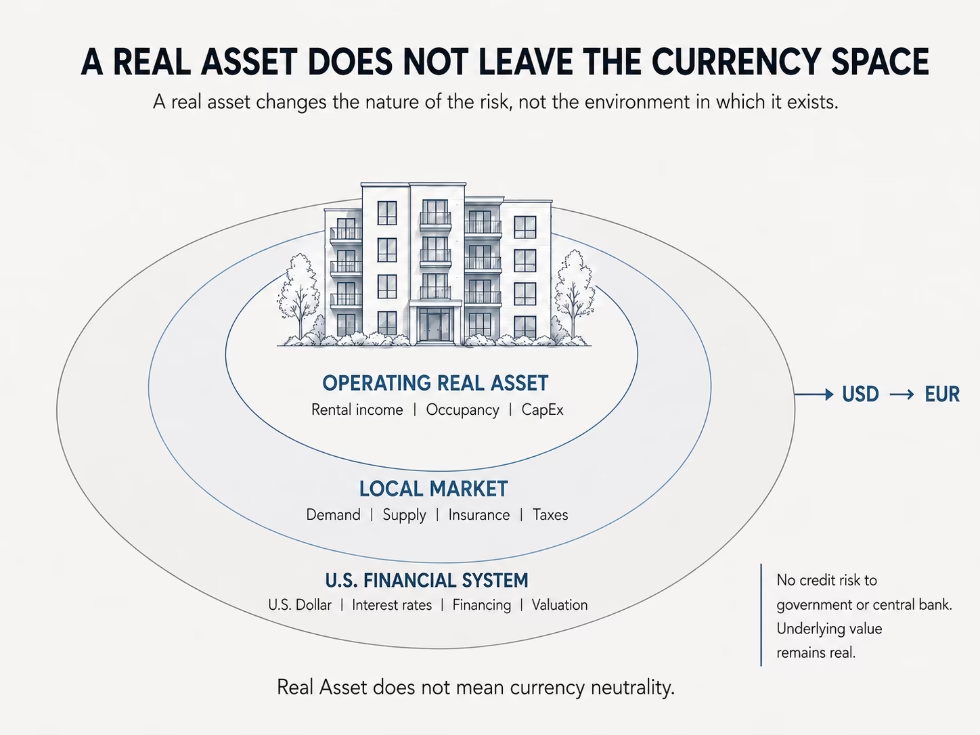
The currency dimension is equally noteworthy. Sixty-five percent of the family offices surveyed expect confidence in the US dollar’s role as a reserve currency to decline, while 47 percent already describe themselves as overweight the US dollar. Yet the UBS Global Family Office Report 2026 does not describe the response as a retreat from US assets, but as broader diversification across currencies and regions. The euro and Swiss franc are gaining importance as complements, while North America remains the largest regional allocation.
For a family investing in US multifamily, the implication is more prosaic: an apartment complex in Florida may be a tangible, cash-flow-generating asset, but it remains part of an economic and financial environment shaped by the US dollar. Rental income, financing, valuation and exit proceeds are all denominated in dollars, while performance also depends on local factors such as demand, supply, insurance, taxes and interest rates. An investment of this kind therefore does not eliminate currency risk or US exposure. It is not a way out of the dollar, but a different form of US exposure: an operating real asset with its own return and risk profile.
Reducing one risk often means taking on another.
The task is not to make risk disappear. It is to understand which risks the family is prepared to carry in the future.
A Family Office May Emerge — But It Does Not Have To
A business sale does not automatically lead to the creation of a single family office. There is no universal blueprint here either, as we discussed in our article on working with family offices.
In some entrepreneurial families, structures around private wealth exist long before the exit. Real estate, business interests or securities portfolios may already be overseen by the CFO, a senior executive with signing authority, a lawyer or a long-standing trusted adviser. A kind of embedded family office can emerge within the existing business before it eventually becomes a separate organization.
After a major liquidity event, that structure may evolve into a standalone family office. Another family may choose a multi-family office. A third may deliberately keep its own organization lean and work with external specialists.
What matters is not the sign on the door, but whether responsibilities and decision-making processes actually work. An exit therefore rarely creates a need for more staff. It creates a need for clarity about who makes the decision when it matters.
Real Estate Must Serve a Purpose After an Exit
Why the United States Still Matters to European Families
Real estate has traditionally formed part of many large fortunes. That does not mean an entrepreneur should invest a substantial share of newly available liquidity in real estate as quickly as possible after a sale.
Professional family offices in particular are currently becoming more selective.
According to UBS, the average real estate allocation among the family offices surveyed was 11 percent in 2025. For 2026, those changing their strategic allocation plan an average allocation of 8 percent.
For a company that offers real estate investments itself, that is an uncomfortable but important figure. It challenges the convenient assumption that professional capital allocators invariably want more real estate in their portfolios. Clearly, they do not.
What matters is not the asset class in itself, but the function an individual asset is expected to perform within the overall wealth structure:
- Should it generate current income or provide geographic diversification?
- Should it deliberately be held for the long term and remain illiquid?
- What currency and financing are involved, how dependent is the investment on a local operator, and what risks arise from taxes, insurance or the specific submarket?
Only once these questions have been answered does “real estate belongs in large portfolios” become a defensible investment decision.
The discussion about diversification should not be confused with a retreat from the United States.
On the contrary, North America remains a central investment market for European family offices, as we have already shown in our analysis of institutional investors in the US housing market. According to the latest UBS report, North America accounts for 45 percent of the regional allocation of European family offices outside Switzerland. At the same time, many families are seeking to diversify existing concentrations more deliberately across regions and currencies.
For us, this distinction is important. We would not recommend that anyone invest in US multifamily simply because Florida is growing, the dollar is a global reserve currency or American real estate appears international. That is not enough.
A US real estate investment has to earn its place in the portfolio.
Once a family decides to build part of its real estate allocation in the United States, however, the next question changes: who can actually assess and manage that part of the portfolio on the ground?

After an Exit, Specialization Matters More Than Knowing Everything
An entrepreneur was able to control the business because expertise had been built there over many years. That expertise cannot simply be multiplied after an exit.
No one becomes a specialist in US multifamily, private equity, global equities, infrastructure, bonds, tax structures and every relevant jurisdiction at the same time.
Professionalization therefore does not mean recreating every capability in-house. It means separating decision-making authority from specialist operating expertise.
The family decides, for example, whether it wants US real estate exposure, what share it may represent, what holding period is acceptable and what risk profile fits the overall structure.
A local real estate operator, by contrast, should be able to answer which submarkets work, at what price an asset becomes attractive, which rents are actually achievable, how the financing can be structured, what local property management can deliver and where a business plan becomes vulnerable.

Whitestone does not make decisions about a family’s overall wealth. That is neither our role nor our area of expertise.
Our role begins once a family has decided that US multifamily should play a part within its real estate allocation.
From that point onward, we are responsible for ensuring that this component performs: operationally, financially and throughout the entire investment period.
The Most Important Change After an Exit Is Not Financial
In the public narrative, a business sale is usually treated as an endpoint: a lifetime’s work that was built, sold and translated into a number on a bank statement.
From a capital-allocation perspective, however, that is where a new phase begins.
The capability that built a fortune is rarely the same capability that sustains it over decades. Before the exit, the strength lay in understanding one thing more deeply than any competitor. Afterward, the real responsibility lies in deciding whom to trust in areas the family itself will never understand as thoroughly as it understood its own business.
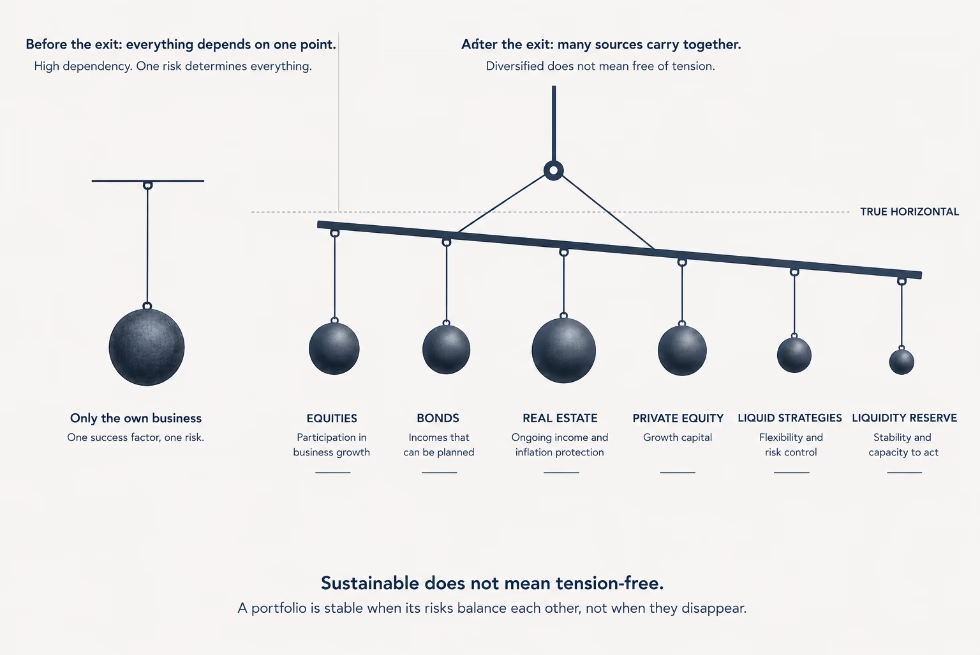
This is not a task that can be solved by increasing the number of products held, and it should not be rushed. It requires structure, patience and a willingness to make a decision only once it has genuinely been thought through — not simply because an adviser happens to present a suitable opportunity.
This leads to the central lesson for every family after an exit: an entrepreneur does not need to become an investor who can do everything personally.
They need to become a capital allocator who knows which decisions must remain with the family and which tasks require specialists.
That is where liquidity begins to become wealth again. Not as a number in an account, but as something one generation has built and the next can preserve.