


The Numbers Reveal the Weakness
Updated in October 2026.
Economic uncertainty is evident in everyday life: stores are closing, companies are postponing investment, and many households are watching their spending more closely. Germany remains a wealthy country. The question is how resilient the foundations of that prosperity still are.
The insolvency figures show the pressure on businesses: 24,064 corporate insolvencies were recorded in 2025, 10.3 percent more than the previous year. A modest recovery in the overall economy is clearly not reaching every business. Behind each insolvency are lost jobs, unpaid claims and businesses built over a lifetime.
Sentiment cannot be explained by a single growth figure. Businesses need predictable energy prices, available skilled workers and permits issued within a timeframe they can plan around. Without these conditions, a positive annual result for the economy as a whole offers only limited relief.
After two years of recession, gross domestic product grew by 0.2 percent in 2025. The revised figures for 2023 and 2024 are −0.9 and −0.5 percent, respectively. In its autumn forecast, the federal government expects growth of 1.3 percent in 2026. That is an improvement, but it is not enough to give the all-clear on structural problems.
An economic recovery and long-term competitiveness are two different questions. Additional public spending or stronger export demand can stimulate output. Whether Germany becomes a more attractive business location over the long term depends on productivity, investment and the conditions companies face.
In autumn 2026, the Kiel Institute describes a fragile recovery with structural weaknesses still unresolved. Private investment remains subdued, while infrastructure and defense spending provide stimulus. An economy can return to growth and still fall short of its potential on important issues that shape its future.
For a country that relied on its industrial base for decades, this is no peripheral issue. What matters is whether companies build their next production facility, research center or expansion here. Such decisions shape prosperity far beyond any single economic report.
Purchasing power and inflation also require careful interpretation. According to Destatis, consumer prices in August 2026 were 2.9 percent above their level a year earlier. A lower inflation rate than during the energy crisis does not mean a return to earlier prices. Households continue to feel the higher price level in rents, food and services. This does not, however, imply an additional, statistically hidden contraction in GDP: real economic output is already adjusted for prices.

Growth alone tells us little about its quality. GDP includes the provision of public services, such as those delivered by schools, hospitals and government agencies. As many of these services have no market price, their value added is measured primarily by their costs. Higher personnel spending can therefore increase the recorded result.
That does not make public services worthless. A functioning legal system, good schools and reliable infrastructure create the conditions for private value creation. The key question is whether additional spending actually improves performance or merely makes existing processes more expensive. A higher government share of the economy does not answer that question.
The image of a “wealthy country” and an unbeatable exporting nation was reassuring. It was easy to relax in the belief that Germany was inherently strong. The reality is that investment in infrastructure, technology and education fell short for years.
The United States attracts attention with major investment projects in semiconductor manufacturing and technology. There, too, delays and costly subsidy programs are part of the picture. Germany must be judged by how quickly an announced investment becomes an operating production site. Lengthy debates about locations and unclear permitting processes can deter capital just as much as high costs.
The speed of planning and implementation matters when choosing a business location. A factory that begins operating sooner generates revenue and creates jobs sooner. For investors, the time between committing capital and putting it to productive use is therefore part of the calculation.
The real problem is not that Germany had two bad years. The recovery in 2026 is welcome, but it does not eliminate the maintenance backlog or weak incentives to invest. A temporary improvement in the economy must not become an excuse to postpone necessary reforms once again.
Unpopular truths were rarely voiced—for example, that our energy policy carries substantial costs, or that the labor market cannot remain stable without immigration. We are already seeing the consequences.

Competitiveness remains an important test. In the IMD World Competitiveness Ranking 2026, Germany ranks 23rd, compared with 19th in 2025 and 24th in 2024. The trajectory is therefore not an uninterrupted decline, but it shows that the improvement achieved the previous year could not be sustained.
A ranking is no substitute for analyzing a business location. It combines different criteria, ranging from economic performance to government efficiency and infrastructure. For an individual company, the conditions in its industry and at its particular location matter most. High energy prices, complex tax rules or lengthy procedures can make an investment unattractive even when other areas perform well.
The pattern remains troubling: Germany has substantial financial resources and is allocating additional billions to infrastructure. Yet bridges still need repairing, schools need modernizing and administrative procedures need accelerating. An approved budget does not resurface a road. It is rather like repainting the facade while repeatedly postponing a necessary roof repair. Only work actually completed improves the condition of a building—and, similarly, of an economy.
How We Got Here
As early as 2018, economist Daniel Stelter warned against overestimating job security, purchasing power and wealth. That warning remains relevant. Money held in a low-interest savings account or an insurance policy loses value in real terms if its return stays below inflation. What matters is the return, costs and purchasing power over the entire term.
We also underestimate the long-term obligations arising from statutory pensions, civil-service pensions and healthcare. These are not the same as recorded government debt, but they place a burden on future budgets and those paying contributions. An aging population intensifies the pressure: fewer people in employment must finance benefits for more people. Without higher productivity, longer working lives or better integration into the labor market, this conflict becomes harder to resolve.

For years, we settled into a politics of convenience. Major issues affecting the future were deferred or obscured by symbolic projects. Infrastructure, education and skilled immigration now need greater attention. The results of these omissions are visible: deteriorating roads, slow administrative procedures and shortcomings in basic school skills. New funding is available; putting it to productive use remains the real task.
Recognition of foreign qualifications is one example. Without a reliable route into employment, even well-trained people cannot make full use of their skills. Germany has since expanded its rules for skilled immigration. What matters is whether visas, recognition of qualifications and the start of employment fit together promptly in practice. Long waits frustrate applicants and businesses looking for staff alike.
The situation resembles a gradual erosion of the country’s underlying strengths. Its effects appear in countless small constraints: delayed trains, overloaded schools, slow government agencies and rising contributions. Each individual case may seem bearable. Taken together, they reveal how costly deferred modernization can become. Yesterday’s prosperity is no substitute for renewing its foundations.
Is the Debt Brake to Blame?
One of the most popular explanations is that “the debt brake prevents anything good from happening.” That is too simplistic. Financing rules can constrain investment, but additional borrowing does not guarantee better outcomes. Since the constitutional amendment in March 2025, the €500 billion special fund has created substantial additional financing capacity for infrastructure and climate neutrality. In 2026, the problem can therefore no longer be explained solely by a lack of borrowing capacity.
Sweden offers an instructive example. In the early 1990s, the country was in a deep crisis: banks were faltering, public debt was rising and confidence in the currency had been damaged. Policymakers responded with a combination of stabilization and reform. The budget was consolidated and rules introduced to align spending decisions more closely with long-term sustainability.

At the same time, the foundations for later investment and a productive economy were renewed. Sweden shows that fiscal discipline and modernization can go together. This does not provide a simple blueprint for Germany; countries differ in their administration, economies and populations. But the experience supports considering the quality of spending and its financing together.
The danger lies in the habit of covering up structural problems with ever more borrowing. Investment in rail lines, networks or education can increase future capacity. Permanently debt-financed current spending, by contrast, creates obligations without automatically generating an additional earnings base. The bill is then pushed into the future.
For 2026, the federal government budgets around €30 billion in interest expenditure. This figure concerns the federal budget, not the whole German public sector. Even this amount shows how much money is committed to past financing rather than new priorities. As debt rises, interest rates, maturities and the sustainability of future revenues become increasingly important.
What we need is a different culture of spending and investment. Expenditure should be assessed by whether it creates a measurable benefit in five or ten years: higher productivity, better infrastructure or greater educational opportunity. Services without an immediate financial return may also be necessary. Their costs and objectives must nevertheless remain transparent. This helps distinguish funding that enables a better future from funding that merely prolongs the status quo.
When Feeling Overrides Evidence, There Is a Price to Pay

In many debates, Germany tends to confuse feelings with certainties. Outrage attracts attention, and moral narratives often set the direction. That is of little help on issues requiring verifiable facts. Even a position argued convincingly must withstand objective scrutiny.
Whether the issue is energy policy, migration or the economy, decisions need transparent assumptions and measurable consequences. Perceived inflation may explain why households are dissatisfied. It cannot replace a price index or a calculation of real wages. Policymakers must take these experiences seriously while making clear which data support a decision.

The danger of a society driven by feeling is that the desired outcome displaces scrutiny of the conditions needed to achieve it. In energy policy, this becomes particularly expensive. Models help only when their assumptions are disclosed and tested against real construction schedules, costs and technical limits. A calculation that works only under favorable conditions is a weak foundation for long-term investment.
Criticism of science must also remain precise. Research in Germany is not funded almost exclusively by the state: in 2024, the business sector carried out around two-thirds of all research expenditure. Public funding remains important for universities and many institutes. That does not automatically imply political control of every result. What matters is transparent methodology, verifiable data and room for reasoned disagreement.
Practitioners must be represented where important decisions are made: people who operate power plants, maintain networks or implement permitting procedures. They understand the bottlenecks between planning and operation. Without that experience, even technically sophisticated concepts can fail in implementation.
Incomplete planning produces ambitious goals whose costs and time requirements become apparent too late. When building a power line or a wind farm, permitting, grid connection, financing and construction must fit together. A political target does not shorten these steps.
Then there is basic physics: electricity generation and consumption must match at all times. Storage, networks, controllable generation and European electricity trading make different contributions. Their capabilities and limits belong in any credible plan, including the cost of reserves that are rarely needed.
The debate over heating systems shows how changing rules can unsettle planning. The Building Modernization Act has been in force since the end of July 2026; the uniform 65-percent requirement has been removed. Gas and oil heating systems remain permitted, while the long-term climate requirements remain. Property owners therefore need to assess economics over the system’s useful life. Frequently changing rules make precisely that calculation more difficult.
Prominent megaprojects reveal similar problems in planning and execution. Berlin Brandenburg Airport (BER), originally scheduled to open in 2011, did not enter operation until October 2020. For years, safety requirements, coordination and technical execution were not brought together adequately. The subsequent costs of such a delay do not end with the construction budget.
Stuttgart 21 is another example of substantial cost increases. The 2009 financing agreement provided for around €4.5 billion, including a risk allowance. The project developer now states a total project value of around €11.3 billion. Different price levels explain part of the increase, but they do not remove the questions about cost control and credible planning.
These cases show how expensive inadequately tested announcements can become. A project needs clear responsibilities, realistic contingencies and regular review of its assumptions. Political attention is no substitute for that work.
When promises and actual results diverge persistently, citizens and businesses lose trust. Whether a measure works in practice must therefore be part of political accountability from the outset. It must be possible to expose errors before they reach a scale that turns every correction into another major project.
A Cultural Problem: Anticipatory Compliance
From the boardroom to the parent council, a similar pattern can be observed: people avoid open disagreement and withhold criticism because it is uncomfortable. They agree, ask for additional subsidies or hope that difficulties will resolve themselves. Such incentives weaken organizations when problems consequently come to light only very late.
For a long time, this was easier to overlook because growth and rising revenues created room to maneuver. In a weaker economy, the costs become more visible: a growing number of reporting requirements, bottlenecks in government agencies and decisions for which nobody feels responsible. Flawed processes persist particularly long when their costs are spread across many people and nobody is accountable for the overall result.
In December 2024, the ifo Institute reported that surveyed executives attributed 22 percent of their employees’ working time to bureaucratic tasks. The survey of around 450 panel members took place in May 2024. It is not a new measurement for 2026, but remains a concrete indication of the workload imposed by information, documentation and reporting requirements.
Citizens also encounter government agencies that take months to handle simple matters—from a new identity card to a building permit. The same pattern applies in ministries: those who produce short-term headlines are rewarded; those who work on long-term reforms often remain invisible. Administration takes precedence over shaping the future.

This is particularly apparent in subsidy programs. Politicians can immediately gain attention with a new funding package, cut ribbons and demonstrate their determination to act. Whether the programs ever work, whether they genuinely strengthen competitiveness or reduce bureaucracy, becomes clear only years later, when nobody remembers the announcement. The short-term reward goes to the political actor; the long-term costs fall on citizens and businesses.
Everyday handling of business data shows how this workload can take on a life of its own. Information already held by one authority must be submitted and checked again elsewhere. Each individual requirement may be defensible; together they create work that neither improves a product nor speeds up a process. Effective relief starts with identifying and eliminating such duplication.
This creates a culture of looking the other way. Decisions are postponed, risks played down and mistakes covered up. But problems do not disappear when ignored—they grow. The longer they are left unresolved, the harder and more expensive they become to fix. Without plain speaking, the courage to disagree and a willingness to voice uncomfortable truths, this knot will remain untied.
Political Incentives: Why Good People Make Bad Decisions
Germany’s party-list system creates strong incentives to stay close to the party apparatus. Those who repeatedly vote against their parliamentary group’s position may face conflicts over candidacies or roles within the party. Legally, the parliamentary mandate remains independent: members are not bound by instructions or directives. In political practice, however, career expectations and re-election prospects can still constrain their freedom of action.
This conflict becomes particularly visible when important decisions are prepared under severe time pressure. A member of parliament may have substantive doubts while also fearing that dissent would weaken their government or parliamentary group. Party discipline facilitates reliable majorities. It becomes problematic when legitimate objections consequently no longer influence the decision.
There is also a financial dimension. Monthly parliamentary remuneration remains €11,833.47 in 2026, after the increase planned for this year was suspended. Average gross monthly earnings for full-time employees in 2025, excluding special payments, were €4,851. Parliamentary remuneration is roughly 2.4 times that amount. These figures alone say little about the quality of a parliamentary mandate. They do, however, show the economic value of a successful political career and why clear rules governing accountability and independence matter.

This is particularly visible in the major issues of our time: energy, the budget and migration. Parties organize majorities and enable shared programs. At the same time, they control a substantial part of access to parliamentary seats. If conformity becomes the most important prerequisite for political advancement, uniformity becomes a risk. Corrections then become more difficult, even when new data or experience make them necessary.
Switzerland shows how direct democracy can connect political decisions more closely to citizens. The model cannot be transferred unchanged to Germany, but it illustrates the importance of clear accountability. Members of parliament should be able to explain their decisions to their constituencies and take substantive objections seriously. The state also needs a clear focus on the rule of law, security and dependable public services. Detailed interventions are no substitute for these core responsibilities.
Germany has the opportunity to turn a rigid system into one capable of learning. But that would require the courage to limit the power of party apparatuses—and return real responsibility to members of parliament and citizens.
A Clear-Eyed View of the Younger Generation
The younger generation is far less uniform than headlines often suggest. Yes, there are highly politicized groups concerned with climate and identity that attract considerable attention. But alongside them, a very different group is emerging: quiet, motivated to achieve, pragmatic and internationally minded. These are young people who invest in their education, speak several languages, gain experience abroad—and are mobile enough to leave Germany when they see better opportunities elsewhere.
A willingness to move to Zurich, London, Singapore or the United States can have different causes: career opportunities, personal relationships or new experiences. It is not automatically a political verdict. Nevertheless, Germany recorded net outward migration of around 97,000 people with German citizenship in 2025. The statistics do not measure a skills drain or people’s motives. For an aging labor market, however, the question of how to attract and retain qualified people remains important.
Financial conditions also play a role. Salaries in Zurich and Berlin can be compared only to a limited extent without matching occupations, experience and living costs. A clearly defined calculation of the tax burden is more informative. For single average earners without children in 2025, the OECD reports a tax wedge of 49.3 percent in Germany, compared with 30.0 percent in the United States and 23.0 percent in Switzerland. This includes income tax and social security contributions paid by both employer and employee as a proportion of labor costs. It is not a comparison of individual take-home pay, but it illustrates different incentives.

If Germany wants to retain its talent, new subsidy programs or strategy papers are not enough. What matters is the conditions people encounter every day:
- Reliability: commitments are honored.
- Speed: permits do not take years.
- Opportunities to advance: performance is rewarded—not membership of the right political party.
- A culture in which success is recognized rather than viewed with suspicion.
Performance, speed, reliability and opportunities to advance influence the attractiveness of a location. These include good schools, affordable housing and the ability to make career decisions without years of formalities. Mobility is a normal part of life for many young people. Germany must offer reasons to build a future here; it cannot simply assume their attachment to the country.
Tunnel Vision on Redistribution
A look at talk shows on German television often brings the issue into sharp focus: many discussions revolve around redistribution. Who gets more? Who should give something up? Which group is treated fairly, and which bears too little of the burden? These are legitimate questions. But if they displace discussion of the conditions that enable economic performance, the debate remains incomplete.
The foundation of every debate about prosperity—value creation—is rarely discussed. Without rising productivity, investment in the capital stock and innovation, any debate about fairness remains a zero-sum game. All that happens is the redistribution of resources that are already insufficient.
Calls for higher taxes therefore also require an assessment of their effects on work and investment. Higher levies can raise more revenue in the short term. If companies invest less or skilled workers choose other locations, the future revenue base may suffer. The scale of this effect depends on the specific tax and the options available to avoid it. Sustainable financing of social benefits requires a productive economy.

The differences can be illustrated by a simplified income tax comparison for 2026. A married couple filing jointly with $400,000 in taxable ordinary income pays around $81,200 in income tax under the U.S. federal tax schedule, or approximately 20.3 percent. Florida imposes no additional state income tax. Taxable income has already been determined after the applicable deductions.
For a married couple assessed jointly with €400,000 in taxable income, the German income tax schedule for 2026 produces income tax of around €145,700. Including the solidarity surcharge, the total is around €153,700, or 38.4 percent; church tax is not included. Social security contributions are excluded on both sides. The comparison describes income tax on numerically equal amounts in the respective currencies—not equivalent gross salaries or identical standards of living.
Even so, the scale of the difference shows why taxes matter in location decisions. A comprehensive calculation must also take account of social insurance, healthcare, living costs and public services. For business owners, the taxation of their company and the treatment of subsequent distributions are additional factors. A blanket figure for the total burden on every married couple would therefore be misleading.
People and companies willing to perform respond to the conditions they face. They assess how much of an additional return they retain, which risks they assume and whether they can make long-term plans for their capital. The tax rate is one part of that decision, alongside financing, skilled workers and reliable procedures.
Germany must strengthen the foundations of value creation if it wants to maintain its level of social protection. This requires an honest discussion of performance, costs and investment. Redistribution can support social stability; without productive businesses and skilled labor, financing it becomes increasingly difficult.
Energy Policy Needs Sound Foundations

The expansion of wind and solar energy changes the demands placed on the electricity system. The nuclear phase-out is complete, and coal is intended to follow gradually. Networks, storage and controllable reserve capacity therefore become more important. The economic viability of the transition depends on whether these components come together in time and at an acceptable cost.
Energy policy must pass three simple but essential tests:
- Security of supply: electricity must be available at all times. Existing data do not point to an unreliable German grid: for 2024, the Federal Network Agency reported an average of 11.7 minutes of supply interruption per customer, less than in 2023. That is a positive finding. It does not, on its own, answer which generation and reserves an electricity system with a different future mix will require.
- Affordability: businesses must be able to plan for energy costs. For 2026 to date, the BDEW reports an average of 17.2 euro cents per kilowatt-hour for supply contracts with small to medium-sized industrial businesses. Large consumers, procurement strategies and relief measures produce different prices. International comparisons must account for these differences rather than presenting a single figure as the price paid by all industry.
- CO₂ reduction per euro invested: what matters is the volume of emissions a measure avoids over its useful life and the total cost incurred. France and Finland use nuclear power as part of their electricity systems. Germany relies more heavily on renewables. Both approaches require credible calculations covering generation, networks, reserves and financing.
Political targets are no substitute for system planning. Without capable networks, storage and reliably available capacity, the energy transition becomes more expensive and difficult. Successful expansion must also be judged by whether businesses can operate their production securely and assess new investments at an acceptable level of risk.
Other countries combine renewables with nuclear power, gas or different storage solutions. For Germany, what matters is making its chosen path technically and economically viable. That requires realistic expansion plans and early action on bottlenecks. Businesses need to know which capacity will be available, when and at what cost.
Education First—Or Germany Risks Losing Its Middle Class
The foundations of a productive country begin with reading, writing and arithmetic. Early childhood support is essential. Language skills open the door to education, integration and professional success. In the IQB Education Trends study for 2021, just under 19 percent of fourth-grade pupils failed to meet the minimum reading standard. Such early deficits can impair training and employment prospects. Support must therefore begin before difficulties become entrenched over several school years.
Building on that, there must be a clear commitment to achievement, without excuses. Performance must be recognized and rewarded. At the same time, children from disadvantaged families need genuine support so that their background does not determine their future. Equal opportunity does not mean erasing differences, but giving everyone access to the same foundations.
Vocational training also deserves greater recognition. The dual system is respected internationally, yet is losing appeal at home. Securing skilled workers requires raising the financial and social standing of vocational training.

At the same time, STEM subjects deserve particular attention: science, technology, engineering and mathematics. They develop the skills Germany needs in key industries. The German Economic Institute’s Spring 2026 STEM report estimates the qualifications-adjusted skills gap at 133,900 people in March 2026. It has fallen compared with March 2025; substantial shortages remain, particularly in energy and electrical occupations. Economic weakness reduces immediate staffing needs, but does not resolve the long-term challenge of developing the next generation of skilled workers.
Immigration must therefore be considered alongside education and skills development. Depending on the route of entry, qualifications, professional experience, language skills and the prospect of suitable employment matter. An engineer unable to use their qualifications initially contributes no more to innovation than an unfilled apprenticeship position. Schools, universities, businesses and public administration must ensure that existing skills translate into productive work.
The message is simple: there can be no turnaround in productivity without a turnaround in education and integration. Neglecting this foundation puts the competitiveness of future generations at risk.
Migration: Honest Numbers, Sensible Policy
Germany needs immigration that strengthens the labor market. Transparent criteria are important for skilled immigration: education, professional experience, language skills and the ability to put those skills to use in employment. Canada, Australia and New Zealand use different selection processes. Their success cannot be attributed to a points system alone; recognition of qualifications, housing and access to the labor market also play a part.
A look at Canada shows that these systems also continue to evolve. Express Entry considers qualifications, language skills and experience, among other factors. Additional points for a job offer were removed in March 2025. This illustrates the importance of practical design. A selection model that looks good on paper must be reviewed regularly to attract the skills needed and avoid undesirable incentives.
Since June 2024, Germany’s Opportunity Card has likewise offered a route for job seekers that, under certain conditions, is accessible through a points system. Success depends on whether applicants can enter promptly, demonstrate their qualifications and find suitable work. A substantial gap can still remain between a new residence permit and a functioning route into the labor market.
The groups must be distinguished carefully. Employment among deliberately selected skilled workers cannot be compared directly with that of refugees in their first year after arrival. Their starting conditions, language skills, reasons for entry and legal circumstances differ. Prompt procedures and appropriate skills development matter for both groups. Every unnecessary month without employment costs money, delays integration and frustrates people who want to use their abilities.
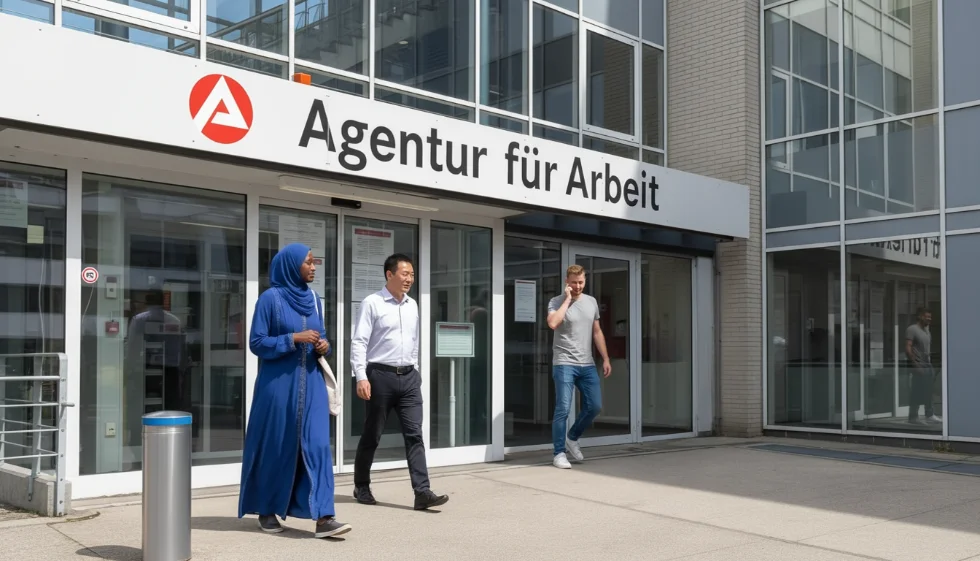
The principle of fairness is equally important. Additional work must be worthwhile financially and socially. This requires understandable transitions between support payments and earned income. Those who need help should receive it; avoidable barriers to entering employment, however, weaken both individuals and the financing of the system.
Only when immigration is managed in this way does it benefit everyone: an economy urgently in need of skilled workers; a society seeking stability; and people who want to build a future here.
Bureaucracy: From Lip Service to Cutting Through Red Tape
Too often, regulation in Germany still changes through additional rules and documentation requirements. Relief packages help only when the workload in businesses actually falls. Existing requirements therefore need systematic scrutiny: which provide necessary protection? Which demand the same information repeatedly? Which have become obsolete through new technology or changed processes?
Sunset clauses are an effective tool. Laws and regulations would no longer remain in force indefinitely, but expire automatically after a set period unless actively reviewed and renewed. This forces administration and policymakers to check regularly whether a rule still makes sense—or has long since become obsolete.
An uncompromising digital-by-default principle is equally important. Procedures should be digital as standard: simple, transparent and understandable to everyone involved. This saves time and costs—and prevents businesses from having to fill binders merely to submit simple applications.
Administrative success should be measured by actual use: how many procedures can be completed entirely online? Which data must citizens or businesses submit again? How long does it take to reach a decision? An online form alone does not make a government agency digital.

Finally, there must be binding deadlines and clear responsibility. Statutory deemed approval can prevent applications from remaining unresolved indefinitely in suitable procedures. Safety requirements, environmental protection and third-party rights must be taken into account. For investors, the main consideration is whether the process is understandable and the timing of a decision can be planned reliably.
On larger construction projects, permits depend on many parties: local government, specialist authorities, utilities and, where applicable, other bodies. If the same documents are reviewed sequentially rather than in parallel, processing time grows. The workload cannot be measured simply by a blanket number of days. The project type, completeness of the application and applicable requirements must be considered.
Comparisons between countries help only when they cover similar projects and procedural steps. A permit for a simple warehouse says little about one for a complex industrial project. Practical decisions require reliable information: which steps are necessary, who reviews them and within what timeframe?
Digital application portals, fixed response deadlines and unambiguous responsibilities can help. Authorities must identify missing documents early and review supplementary information in a targeted manner. Repeated full reviews and unclear requirements tie up staff on both sides without automatically improving the quality of the outcome.
The objective is reliable, predictable implementation. Capital is already committed while an application is reviewed, and delays can change financing costs, construction prices and the eventual return calculation. Countries and municipalities with transparent procedures make investment easier. Germany therefore needs fewer procedural loops and greater accountability for the time actually required.
Subsidies Instead of Results
Public spending needs clear objectives and an assessment of its impact. Particularly in infrastructure and education, costs, time and results must be considered together. A school has not been successfully modernized merely because its budget has been spent. What matters is whether the building and teaching function better, and whether the resources used were appropriate.
Borrowing should primarily finance projects with lasting benefits. The return here means higher productivity, better public services or greater educational opportunity. Ongoing services need sustainably viable financing. The distinction is not always straightforward, but it prevents every political priority from being labeled an investment.
Subsidy programs must be reviewed regularly for their additional impact. A grant can make a necessary investment possible. But it can also finance a purchase that would have happened anyway. Such windfall effects matter just as much in the assessment as administrative costs and potential contributions to the development of new technologies.
One example is the former purchase subsidies for electric and hybrid vehicles. A study published in 2024 in Environmental and Resource Economics examines vehicle registrations from 2015 to 2022. It estimates CO₂ abatement costs attributable to the program at approximately €870 per tonne for battery-electric vehicles and €2,470 for plug-in hybrids. The authors also consider potential learning effects and economies of scale. These figures assess this historical subsidy program; they are not universally applicable costs of electric mobility.

Grants for energy-efficiency renovations require similarly careful assessment. Insulation saves energy over many years, but its economics depend on the building’s initial condition, construction costs and future energy prices. A roof or facade renovation that is necessary anyway must be assessed differently from a comprehensive renovation brought forward solely to save energy.
A single high figure per tonne of CO₂ avoided would therefore not be reliable evidence against all building subsidies. Additional investment costs, energy savings, useful life and windfall effects belong in the calculation. Societal climate damage and abatement costs are also different measures. A meaningful comparison shows which measure achieves more under which conditions—and which subsidy causes unnecessary costs.
Property owners also need to know whether subsidy conditions and technical requirements will remain valid for a predictable period. Frequent changes can delay worthwhile investment. The state should make programs understandable, evaluate their impact transparently and be able to discontinue ineffective instruments. The size of a subsidy budget is not, on its own, evidence of its quality.
Tax Incentives Rather Than Subsidies
A simple, predictable tax system can facilitate investment. Faster depreciation improves the timing of capital recovery without requiring a separate grant application for every purchase. The immediate investment program introduced declining-balance depreciation of up to 30 percent for certain movable fixed assets acquired or manufactured after June 30, 2025 and before January 1, 2028. New tax incentives are therefore already in place for 2026.
Whether these incentives have a sufficient effect also depends on other conditions. More attractive depreciation cannot replace a grid connection, available skilled workers or a viable business plan. Every euro must be judged by its impact. This applies to tax concessions just as much as direct grants. Reliable rules and verifiable results provide the foundation for accountability.
Acting Rather Than Hoping
What, specifically, is needed now? Above all, clarity and courage—in politics, business and society. The remedies are not complicated; they simply require consistent follow-through:
- The courage to disagree: in the workplace, in associations, in parent councils—wherever decisions are prepared or discussed. Lowering our eyes and going along is no longer enough. Anyone who recognizes a problem must name it objectively but audibly. Progress begins with dissent, not silence.
- Set priorities: time, money and attention belong where productivity is created—in education, infrastructure, research and entrepreneurship. Everything else is secondary. The objective must be to use available resources in ways that produce better services and a stronger economic foundation over the long term.
- Resilience to online outrage: not every wave of indignation on X or TikTok is a political earthquake. Those with responsibility must not be knocked off course by every expression of disapproval. Stability comes from staying the course—even against a headwind. That applies in companies just as much as in politics.
- Coalitions of pragmatists: mid-sized businesses, municipalities and practitioners from business and public administration belong at the same table. Their experience is more valuable than many strategy papers. Practical results should be made publicly visible—clearly and pragmatically. Progress must show up in shorter procedures, functioning facilities and infrastructure that is easier to use.
- Develop talent: young people need training, internships and real responsibility—not “after the next reform,” but now. They are the foundation on which everything else rests. Good training strengthens productivity and gives young people a clear route into employment.
- Honesty in investment decisions: businesses and individuals must assess dispassionately whether projects in Germany still make economic sense. Unfavorable conditions can direct capital abroad; international expansion can also open up new markets and strengthen operations in Germany. A location decision must bring together expected returns, costs and risks. Capital is mobile. Germany must therefore offer compelling conditions for investment without treating every foreign venture as capital flight.
Acting rather than hoping: only by taking these steps does Germany have a chance to move from managing the status quo to actively shaping its future.
Change Course Now—Before the Room to Maneuver Shrinks Further
Germany needs less government intervention in the details and stronger government performance in its core responsibilities. Not more symbolic laws that generate headlines, but operational excellence in what truly matters: security, the rule of law, education and infrastructure. Instead, we often experience the opposite—endless detailed regulations and moral appeals while bridges deteriorate, schools lack staff and permits take years.

We need less moral rhetoric and more robust calculations. Evidence should underpin policymaking and public administration. Whether in energy, finance or migration, a persuasive intention must be judged by its results. New data may also show that an earlier assessment needs correcting.
It starts with the everyday actions of businesses, public administration and citizens. That includes reasoned disagreement, a willingness to examine assumptions and the courage to identify mistakes early. Prosperity has to be earned time and again. Its distribution can support a productive economy, but cannot replace one.
The recovery in 2026 gives Germany some room to maneuver. Whether it produces a permanently stronger economy depends on the decisions now being implemented. Additional financing helps only when productive projects follow. Good labor-market rules help only when people actually find suitable employment. For investors, what matters is how these changes affect costs, returns and predictability.
According to the Bundesbank, German investors increased their foreign direct investment through transactions by €97.5 billion in 2025. At the same time, direct investment capital also flowed into Germany. Such movements reflect international corporate relationships and do not, on their own, prove capital flight. They do show, however, that investment and location decisions are made across borders.
Germany still has substantial strengths and the resources to change course. What matters is whether these foundations produce dependable public services, productive businesses and attractive investment conditions. The costs of further delay fall on the people who work, invest and build their future here.